Water around a water heater usually comes from a fitting, a valve or condensation, not from a hole in the tank. A. O. Smith puts it plainly in its 2004 gas manual: “Many suspected ‘Leakers’ are not leaking tanks.” Where the water starts tells you which it is. Water on top points to the pipe connections or condensation. Water at the relief valve or its pipe usually points to pressure. Water at the drain valve points to the valve or its thread. Water seeping from the tank body itself is the one leak that none of the makers’ manuals we read repairs: the heater is replaced. This page walks through all four spots in the order of the leak finder on our front page, with the makers’ own checks and stops. For other symptoms, start at Problems and Leaks.
General information, not professional advice. Gas, 240-volt power, scalding water and a pressurised tank can hurt you. Follow the label and manual on your own heater; where they say to stop and call a qualified technician, stop. Codes and licensing rules are set locally.
Before you look for the leak
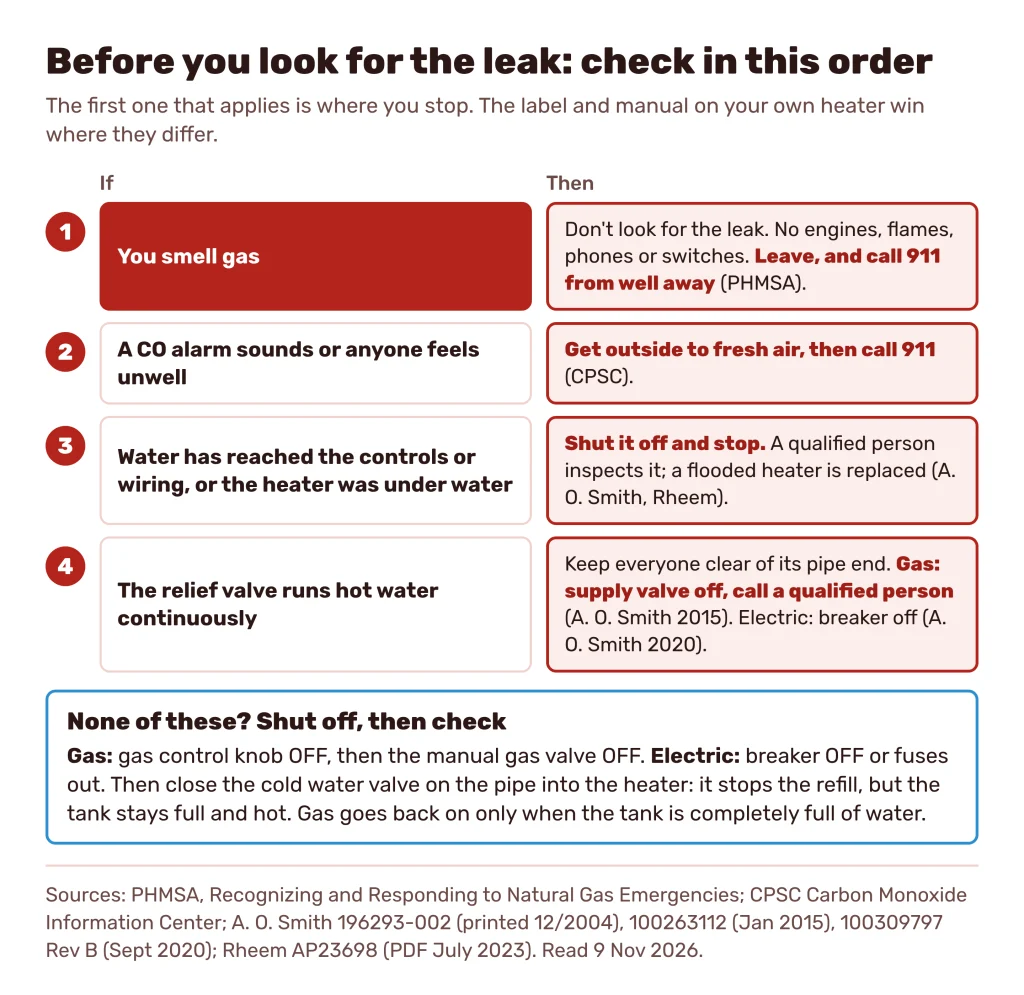
If you smell gas, don’t look for the leak. PHMSA, the federal pipeline safety agency, says: do not “start an engine of any kind”, strike a match or make a flame, use a telephone or cell phone, or turn any light switch, garage door opener or other switch on or off. Make sure gas appliances are turned all the way off if you can, leave the area, and “telephone 911 from a neighbor’s house or other location well away from the gas leak”. The makers’ labels add: call your gas supplier from a neighbor’s phone, and the fire department if you can’t reach them. Don’t go back in until they tell you to. More on our gas smell and carbon monoxide page.
If a carbon monoxide alarm sounds or anyone feels unwell, CPSC lists the symptoms as “headache, dizziness, weakness, nausea, vomiting, sleepiness, and confusion” and says: “If you suspect CO poisoning, get outside to fresh air immediately, and then call 911.” On a gas heater, water dripping at the draft hood (the metal cap where the flue meets the vent pipe) is a vent problem, not a plumbing leak: A. O. Smith’s manual says to contact the gas utility.
Shut off before you check. A. O. Smith’s leak guide starts with the gas: make sure the supply is off before checking the heater, and never turn the gas back on before the tank is completely full of water. Its 2015 gas guide (100263112) gives the order in its draining steps: gas control knob to OFF, then the manual gas valve on the heater’s supply line to OFF, and, after running a hot tap until the water is cool, the cold water supply valve to the heater OFF. Its 2020 electric guide (100309797) starts instead with the heater’s circuit breaker OFF, or its fuses out. The model code calls for a readily accessible full-open valve on the cold supply at or near the heater (2024 IRC P2903.10.2), so look for it on the cold pipe near the heater. Closing it stops the tank refilling; it does not empty the tank, and the water inside stays hot.
If water has reached the controls or wiring, or the heater has been under water, stop there. A. O. Smith’s gas and electric guides say to shut the heater off at once and have it inspected by a qualified person if the wiring, thermostat or surrounding insulation has been exposed to water in any way, leaks from the heater itself included, and that a heater subjected to flood conditions is replaced. Rheem says the same of a flooded heater. Bradford White’s gas manual has a qualified service technician inspect it and replace any part of the control system that was under water. None of them says to relight or power it as it stands.
If the relief valve is running hot water continuously, keep everyone clear of the end of its pipe. A. O. Smith’s 2015 gas guide: a large amount of very hot water from the relief valve may mean the tank is overheating; turn the gas supply valve off and call a qualified person. Its 2004 manual: if the valve keeps releasing water after it has been operated, close the cold water inlet to the heater at once. On an electric heater, A. O. Smith’s 2020 guide says a large amount of very hot water from the valve is likely a shorted heating element or, more rarely, a thermostat problem, and to turn the power off until it is fixed.
First, find where the water starts
Water runs downhill, along pipes and down the outside of the jacket, so a puddle under the tank says little about where the leak is. The makers’ checks start by ruling things out.
- Is it condensation? On a gas heater, the burner’s own exhaust carries water vapor. When the tank is full of cold water, that vapor condenses on the cool tank and drips onto the burner with a sizzling sound. Cold water pipes can also bead with condensation in humid weather (A. O. Smith 2004, checkpoint B). Rheem, A. O. Smith and Bradford White all call this normal and say it goes away once the water is hot; A. O. Smith’s older manual says to allow about 1 to 2 hours before assuming a leak. It shows up most after a big hot water draw, when a new heater is first filled, and in winter and early spring when incoming water is coldest. Rheem’s line on what comes next: if the condensation continues, examine the piping and fittings for possible leaks.
- Is it something else nearby? A. O. Smith’s leak checklist ends with leakage from other appliances, water lines or ground seepage. Look at what sits above and beside the heater: a furnace or air conditioner drain, a water softener, a washer hose, the pipes running across the ceiling.
- Dry it and watch. A. O. Smith’s installation steps say to dry the pipe connections so any drips or leaks will be apparent. Wipe the tank top, the fittings, the relief valve and pipe, and the drain valve dry, put a dry towel or a shallow pan under any drip, and look again in a while. The first spot to get wet is your answer.
| Where the water is | Most likely, by the makers’ checklists | Section |
|---|---|---|
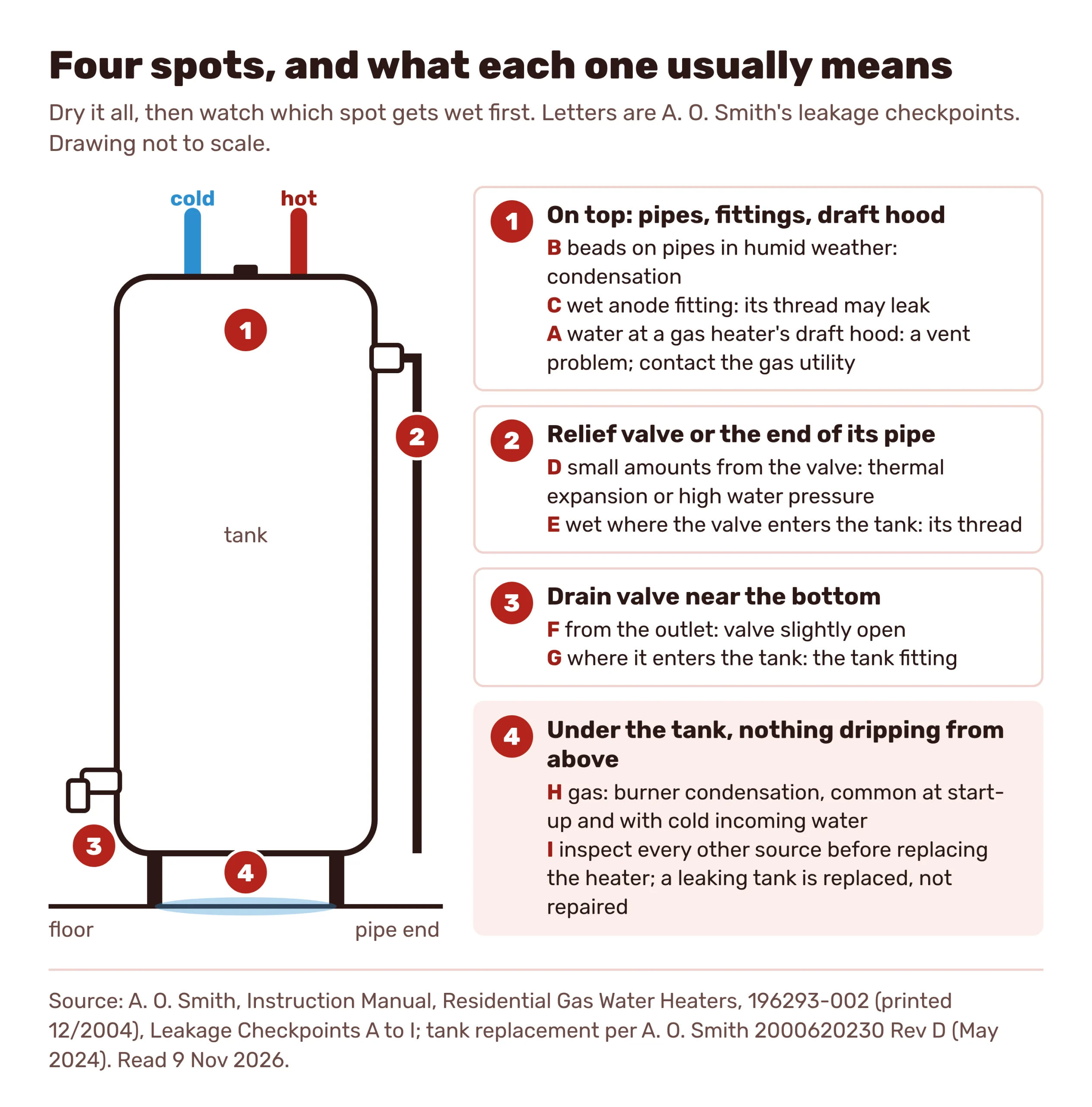
| Pipes and fittings on top, the anode fitting, the draft hood | A loose or failing connection, condensation on cold pipes, or (at the draft hood) a vent problem | On top |
| The relief valve or the end of its discharge pipe | High water pressure or thermal expansion; sometimes debris or a broken valve; a leak where the valve threads into the tank | Relief valve |
| The drain valve near the bottom | A valve not fully closed, or a leak where it threads into the tank | Drain valve |
| Under the tank, with nothing dripping from above | Condensation from the burner, an element gasket on an electric heater, or the tank itself | Under the tank |
On top: pipes, fittings and condensation
The top of a tank heater carries the cold water inlet, the hot water outlet and, on many models, the hex head of the anode rod, the metal rod that corrodes in place of the tank (on some Bradford White heaters the anode is built into the hot outlet fitting instead). A gas heater also has its flue and draft hood there. A. O. Smith’s 2015 gas guide, in the step where the installer checks the new connections, says almost all leaks occur at connections and are not a tank leak; its 2020 electric guide says leaks are frequently in the plumbing system itself and not the water heater.
- Beads on the pipes in humid weather can be condensation rather than a leak (A. O. Smith 2004, checkpoint B).
- A wet connection where the inlet or outlet pipe joins the heater, or a drip from a flexible connector or union above it, is a plumbing leak. A. O. Smith’s 2004 troubleshooting table lists “improperly sealed” hot or cold connections, and the fix it gives is to tighten threaded connections, but that table is headed as guidelines to be used by a qualified service agent.
- A wet anode fitting means the threads where the anode screws into the tank may be leaking (checkpoint C). Use the check below to tell a thread leak from water running past.
- Water at the draft hood on a gas heater is condensed exhaust and a sign of a vent problem (checkpoint A): contact the gas utility, and see the safety box above.
A. O. Smith’s check for a leaking tank fitting
For the three fittings that thread into the tank (the anode, the relief valve and the drain valve), A. O. Smith’s 2004 manual for its older hand-lit gas heaters gives this check: push a cotton swab between the jacket opening and the fitting, where the threaded part enters the tank. If the cotton comes out wet, the fitting’s thread is leaking. That manual’s repair is to drain the tank per its draining instructions, remove the fitting, put pipe dope or Teflon tape on the threads, refit it and refill the tank. Its newer guides say to contact a qualified person if you can’t do routine maintenance tasks, and that an anode must stay installed at all times or the tank warranty is void. Follow the manual for your own model; the tank is completely full before the gas goes back on, and on an electric heater before the power goes back on (A. O. Smith’s 2020 electric guide: power on an empty tank burns out the upper element).
At the relief valve or its pipe
The temperature and pressure relief valve, or T&P valve, is the brass valve near the top of the tank with a lever and a pipe running down the side. It opens to let water out when the tank gets too hot or the pressure too high. Under the 2024 International Residential Code (IRC), the model code many states and cities adopt with their own changes, its pipe ends no more than 6 inches above the floor or drain it empties onto, so a dripping relief valve often looks like a puddle under the heater (P2804.6.1). Follow the pipe up before deciding where your water comes from.
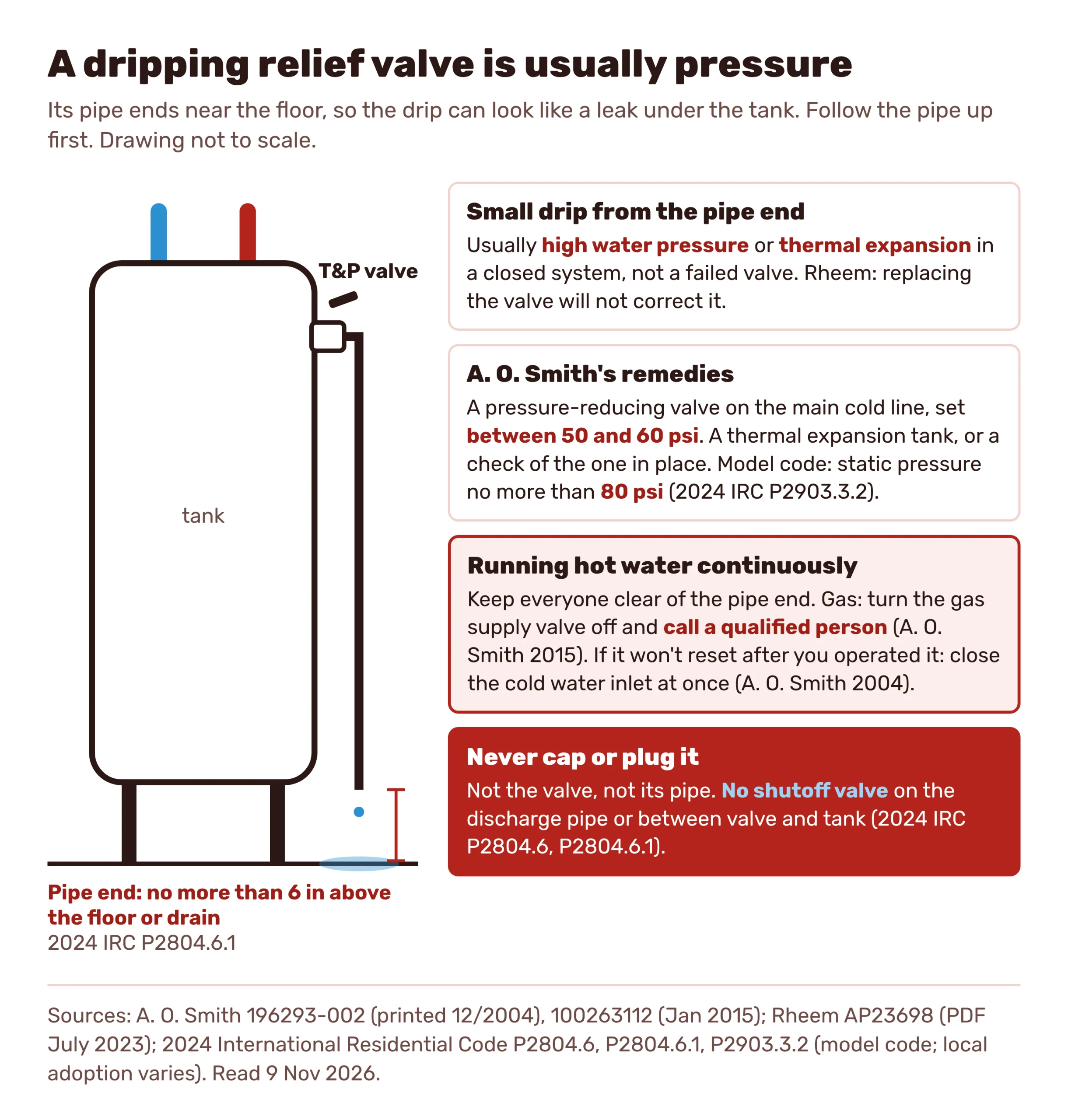
A small drip from the end of the pipe is usually pressure, not a failed valve. A. O. Smith’s 2004 checklist says small amounts of water from the relief valve may be due to thermal expansion or high water pressure (checkpoint D); its 2015 guide says a small drip usually means the home’s water pressure is too high and/or a thermal expansion tank is needed. Thermal expansion is the water in the tank growing as it heats. In a “closed” system, where a check valve, backflow preventer or pressure-reducing valve stops it flowing back to the main, the pressure climbs until the relief valve opens. Rheem’s manual adds a line worth knowing before the valve is blamed: replacing the relief valve will not correct the problem. A. O. Smith’s remedies:
- a pressure-reducing valve on the main cold water line, adjusted to between 50 and 60 psi (A. O. Smith 2015); the 2024 IRC caps static water pressure at 80 psi, with a pressure-reducing valve above that (P2903.3.2);
- a thermal expansion tank, or, if one is already in, a check of that tank: A. O. Smith says the home’s pressure may still be too high or the expansion tank may be defective, and its heat pump service handbook adds that the tank may be charged to the wrong pressure or have a failed bladder. Our expansion tank calculator shows how much the water in your tank expands.
Bradford White’s and Rheem’s manuals say to contact the water supplier, the local plumbing inspector or a plumbing contractor about a valve that discharges now and then, and Bradford White’s warranty does not cover damage from thermal expansion, such as pressure bulges in the tank.
Water around the valve body, at the tank, rather than from the pipe, may be the thread where the valve enters the tank (checkpoint E). Use the cotton swab check above.
A valve that won’t stop after it has been opened is where the makers differ. A. O. Smith’s 2004 manual says: if, after you operate the valve by hand, it fails to reset and keeps releasing water, close the cold water inlet at once, drain the heater and replace the valve. Its 2015 guide says that if pressure is 50 to 60 psi, an expansion tank is installed and properly charged, debris has been flushed out by working the lever, and it still drips, the valve may be broken: have a qualified person replace it. On inspection, the same 2015 guide gives two intervals: its maintenance page says to have a qualified person remove and inspect the valve and its discharge pipe at least every five years, while the maintenance note on its page 3 says to inspect the valve every 2 to 4 years and points to the label on the valve for the schedule. Follow the label on your own valve.
Whoever does the work, every maker read for this page says the same thing about the valve itself: never cap or plug the relief valve or its pipe. A. O. Smith warns that blocking it could cause an explosion. The model code adds no shutoff valve between the relief valve and the tank, none on the discharge pipe, and a pipe no smaller than the valve outlet (2024 IRC P2804.6 and P2804.6.1). The full story, including the yearly lever test and its cautions, is on our relief valve leaking page.
At the drain valve
The drain valve sits near the bottom of a tank heater, with a garden hose thread on its outlet (the 2024 IRC calls for one on every tank-type heater, P2801.1). It leaks in two ways.
- From the outlet: A. O. Smith’s checkpoint F says water from a drain valve may be due to the valve being slightly open. Bradford White’s manuals close it by turning the knob clockwise, or, on electric models with a slotted valve, with a flat screwdriver in the slot. A. O. Smith’s 2015 guide also notes that sediment from the bottom of the tank can clog the valve and keep it from draining; if you can’t get the tank to drain, it says to contact a qualified person.
- Where it enters the tank: checkpoint G says the drain valve may be leaking at the tank fitting. The cotton swab check applies here too.
If it keeps dripping with the handle closed, the valve or its washer may be at fault. None of the manuals read for this page gives owner steps for replacing a whole drain valve. A. O. Smith’s 2004 manual does give a drain valve washer replacement, for selected models with plastic drain valves only: gas supply off, drain the tank per its draining steps, unscrew the hex cap below the screw handle counterclockwise, fit a new washer, screw the handle and cap back and retighten with a wrench (its words: “DO NOT OVER TIGHTEN”), refill the tank, check for leaks, then relight by the lighting instructions. If your valve or manual differs, follow your manual. Its procedure for a leaking fitting also starts by draining the tank. Our draining guide sets out the makers’ steps and stops: water run until cool first, gas or power off, and the tank completely full again before the gas or power goes back on.
Under the tank: could it be the tank itself?
Water under the heater with nothing dripping from above is the case people fear most, and the one A. O. Smith warns about hardest: water in the bottom of the heater or on the floor may be from condensation, loose connections or the relief valve, and it says not to replace the heater until all possible water sources have been inspected (checkpoint I). Work through these first.
- Condensation from the burner (gas): exhaust water vapor condenses on the cooler tank, drips onto the burner and can run onto the floor. A. O. Smith calls this common at start-up after installation and when incoming water is cold (checkpoint H). Its older manual adds that an undersized heater makes more condensation, and that heavy condensation can put the pilot out.
- The relief valve pipe: see above. It ends near the floor by design.
- An element gasket (electric): an electric heater has one or two heating elements screwed into the side of the tank behind access panels, each sealed with a gasket. Bradford White’s electric manual lists checking the seal around the elements for leaks among its maintenance for a qualified service technician, and if there is any sign of leaking says to disconnect the power and contact the installing plumbing professional or a qualified service technician. A. O. Smith’s element steps start with the breaker off before any panel comes off, and its guide treats water on the wiring or insulation as a shut-off-and-inspect matter.
If it is the tank, no maker read for this page gives a repair. A. O. Smith’s guides say that, due to the normal corrosive action of water, the tank will eventually leak, which is why they ask for a drain pan in any spot where a leak would cause damage. A. O. Smith’s 2024 service handbook for its heat pump models, written for qualified service professionals, puts one step of its water leak code plainly: if the tank is leaking, replace the unit. When every fitting above is dry, the relief valve pipe is dry, condensation has had time to clear and water still collects under the tank, the makers’ checklist points to the tank. Turn off the gas or power, close the cold inlet, and plan for a replacement; prices vary, so get written quotes. If you’re not sure how old the heater is, our water heater age lookup reads the serial number for the brands whose format we have confirmed. More detail on the bottom of the tank is on our leaking from the bottom page.
Is a leaking water heater dangerous?
A slow drip from a fitting is mostly a water damage problem, but the makers point to four ways a leak can become more than that.
- Water on controls and wiring. A. O. Smith says leaks from plumbing or from the heater itself can damage property and could cause a fire risk, and that a heater whose wiring, thermostat or insulation has been wet is shut off and inspected.
- Scalding water. The relief valve and drain valve release tank-hot water. Rheem’s manual says water drained from the tank may be hot enough to present a scald hazard; A. O. Smith’s 2015 guide says to run a hot faucet until the water is cool before draining, which may take 10 minutes or longer.
- Pressure. A relief valve doing its job looks like a leak. Capping it to stop the drip removes the protection the code and the makers require.
- Gas venting. Water at a gas heater’s draft hood is a vent problem, and EPA lists back-drafting from gas water heaters among indoor carbon monoxide sources. CDC advises having a water heater and other gas appliances serviced by a qualified technician every year.
Tankless and heat pump models
Tankless heaters have no storage tank, but they still have water connections, a pressure relief valve and, on condensing models, a condensate drain. Rinnai’s N-series condensing manual (100000467, 6/2020) has the relief valve and the condensate drain piped separately to a drain, says a periodically discharging relief valve may be thermal expansion in a closed system (contact the water supplier or local plumbing inspector), and says not to plug the valve. Rinnai also says repairs and maintenance shall be performed by a trained and qualified professional. Check the manual for your own model and series.
Heat pump water heaters pull moisture out of the room air, so they make condensate water that runs through a drain pan, drain valve and lines. A. O. Smith’s 2024 service handbook for its hybrid models (2000620230 Rev D) says the condensate pan, valve and lines need routine inspection so a blockage doesn’t overflow the pan, that water from the condensate drain’s overflow slot means both condensate lines may be blocked and immediate action is required, and that some of its models show a leak alert code. That handbook is written for qualified service professionals only, so take the code to one.
Pans and leak sensors
Because a tank will eventually leak, in A. O. Smith’s words, the makers ask for a drain pan under heaters in places where a leak would cause damage, piped to an adequate drain, and A. O. Smith suggests an automatic leak detection and shutoff device. The 2024 IRC model code requires a pan in those places, at least 1-1/2 inches deep, drained by a pipe at least 3/4 inch across to a suitable receptor or outdoors; a replacement heater doesn’t need a new pan drain where none was installed before (P2801.5 to P2801.5.2). Some Bradford White gas models flash a leak code when an accessory module finds water in the pan. Our drain pan and leak sensor guide covers the choices.
What to do next
- Right now: a gas smell or a CO alarm means leave and call 911 or the gas utility from outside. Otherwise turn the gas control or the breaker off, close the cold water valve on the pipe into the heater, and put a towel or pan under the drip.
- Find the spot: dry everything, wait, and see which of the four spots gets wet first. Give a newly filled or newly lit heater time to warm up before calling it a leak (about 1 to 2 hours, in A. O. Smith’s 2004 manual).
- Read your own manual: the rating plate on the heater gives the maker, model and serial number. Find the manual for that model on the maker’s own website; its leak, relief valve and draining sections win where they differ from ours.
- Call: a licensed plumber for a leaking connection, relief valve, drain valve or tank; the gas utility for water at a gas heater’s draft hood; your water supplier or local plumbing inspector about pressure and thermal expansion. Some states and cities require a licence or a permit for water heater and gas work: ask your building department.
- Can’t wait: a gas smell, a CO alarm, a relief valve running continuously, water seeping from the tank body, and any heater that has been under water.
Sources checked on 9 November 2026.
Sources
- A. O. Smith: Instruction Manual, Residential Gas Water Heaters, part no. 196293-002 (printed 12/2004), Leakage Checkpoints and troubleshooting
- A. O. Smith: Installation Instructions and Use & Care Guide, Residential Atmospheric Gas Water Heater with FVIR, 100263112 (January 2015)
- A. O. Smith: Installation Instructions and Use & Care Guide, Residential Electric Water Heater, 100309797 Rev B (September 2020)
- A. O. Smith: Service Handbook, Residential Hybrid Electric Heat Pump Water Heater, 2000620230 Rev D (May 2024; for qualified service professionals)
- Rheem: Use & Care Manual, Residential Gas Low NOx FVIR, AP23698 (PDF July 2023)
- Bradford White: Installation and Operation Manual, Gas-Fired Water Heater with FVIR, 238-51012-00V (REV 08/26)
- Bradford White: Installation and Operation Manual, Electric Water Heater, 238-44422 (REV 08/26)
- Rinnai: Tankless Water Heater (Residential) Installation and Operation Manual, N series condensing, 100000467(06) (6/2020)
- 2024 International Residential Code, Chapter 28 Water Heaters (P2801.1, P2801.5, P2804.6, P2804.6.1), model code
- 2024 International Residential Code, Chapter 29 (P2903.3.2, P2903.10.2), model code
- PHMSA: Recognizing and Responding to Natural Gas Emergencies in Your Home or Workplace
- CPSC: Carbon Monoxide Information Center
- CDC: Carbon Monoxide Poisoning Basics (updated 26 Oct 2026)
- EPA: Carbon Monoxide's Impact on Indoor Air Quality (updated 15 Jul 2026)