The anode rod is a metal rod screwed into the top of a tank water heater. It corrodes on purpose, so the steel tank doesn’t. How often to check it depends on whose document you read. A. O. Smith’s owner guides say after the first six months, then at least once a year. Rheem’s manuals say take it out for inspection once a year. Bradford White’s manuals say every two years, by a qualified service technician. The Department of Energy’s archived page said every three to four years. Replace it when it’s worn down: Rheem’s test is more than 6 inches of bare core wire showing at either end.
Part of our water heater maintenance guides, this page sets those schedules side by side, shows where the rod sits on gas, electric and heat pump tanks, and gives the replacement steps exactly as the one maker that prints them for owners lays them out, with its stops.
General information, not professional advice. Gas, 240-volt power, scalding water and a pressurised tank can hurt you. Follow the label and manual on your own heater; where they say to stop and call a qualified technician, stop. Codes and licensing rules are set locally.
Before you touch a gas water heater
- If you smell gas: stop. The federal pipeline safety agency, PHMSA, says don’t start an engine, strike a match or make any flame, use a telephone or cell phone, or turn any light or electrical switch on or off (garage door openers too). Make sure gas appliances are turned all the way off if you can, leave the area, and call 911 from a neighbor’s house or somewhere well away from the leak. The makers’ labels add: call the gas supplier from a neighbor’s phone, and the fire department if you can’t reach it. Rheem adds: don’t go back into the home until the gas supplier or fire department says so.
- Carbon monoxide (CO): CDC lists headache, dizziness, weakness, upset stomach, vomiting, chest pain and confusion as the most common symptoms. If you suspect CO, CPSC says get outside to fresh air immediately, then call 911. CDC advises battery-operated or battery-backup CO detectors near every sleeping area, and says to make sure gas appliances are vented properly: a blocked or disconnected vent can send exhaust back into the room.
- Shut-off: on the gas heater the steps below describe, that means the gas control knob to OFF and the manual gas valve on the heater’s supply line closed. Electric and heat pump heaters: the breaker off. Then the cold water supply valve closed before the anode comes out. Before relighting a gas heater, wait the time its lighting label gives.
- A flooded heater is not a maintenance job. A. O. Smith says the entire heater must be replaced if it has been in a flood or its thermostat was under water; Rheem says call a qualified installer or service agency to replace it. Bradford White says don’t use it, and have a qualified service technician inspect it and replace any control part that was under water. Never relight it yourself.
More on what to do, and what not to do, in our guide to a gas smell or carbon monoxide near a water heater. CDC also advises having your water heater and other gas-burning appliances serviced by a qualified technician every year.
What the anode rod does
The tanks in Rheem’s and A. O. Smith’s documents are glass-lined steel. The anode rod, usually a magnesium or aluminum rod around a core wire (A. O. Smith also lists a special zinc one), gives the water something easier to attack. A. O. Smith’s 2004 manual puts it simply: instead of corroding the tank, the water eats away the rod, and this doesn’t affect the water’s taste or color (196293-002, p. 20). Its newer guides call it a sacrificial rod that helps avoid corrosion and early leaks; Rheem says it is slowly consumed to protect the glass-lined tank.
Three things follow from that, all in the makers’ own documents:
- It’s meant to wear out. A. O. Smith calls the rod a consumable item that isn’t covered by the warranty (Use & Care Guide 100263112, January 2015, p. 29). Its Residential Electric Warranty for its Voltex heat pump models says the same: sacrificial anode rods are consumable maintenance parts and are excluded (100350228, September 2021).
- Taking it out for good costs you the tank warranty. A. O. Smith: an anode must be installed at all times or the warranty is void (100263112, p. 26). Rheem: don’t remove it except for inspection or replacement; running without it will greatly shorten the tank’s life and exclude warranty coverage (Rheem AP23698, p. 21). Bradford White: removing any anode except to inspect or replace it nullifies the warranty (238-51012, p. 5).
- The rod can cause a smell. Where the water carries sulfate and certain bacteria, the reaction at the rod can give hot water a rotten-egg smell. The makers’ fixes are a different anode, treating the water, or both (Rheem names only chlorinating the water supply), never running the tank without one: see why a water heater smells like rotten eggs.
Where to find it on your heater
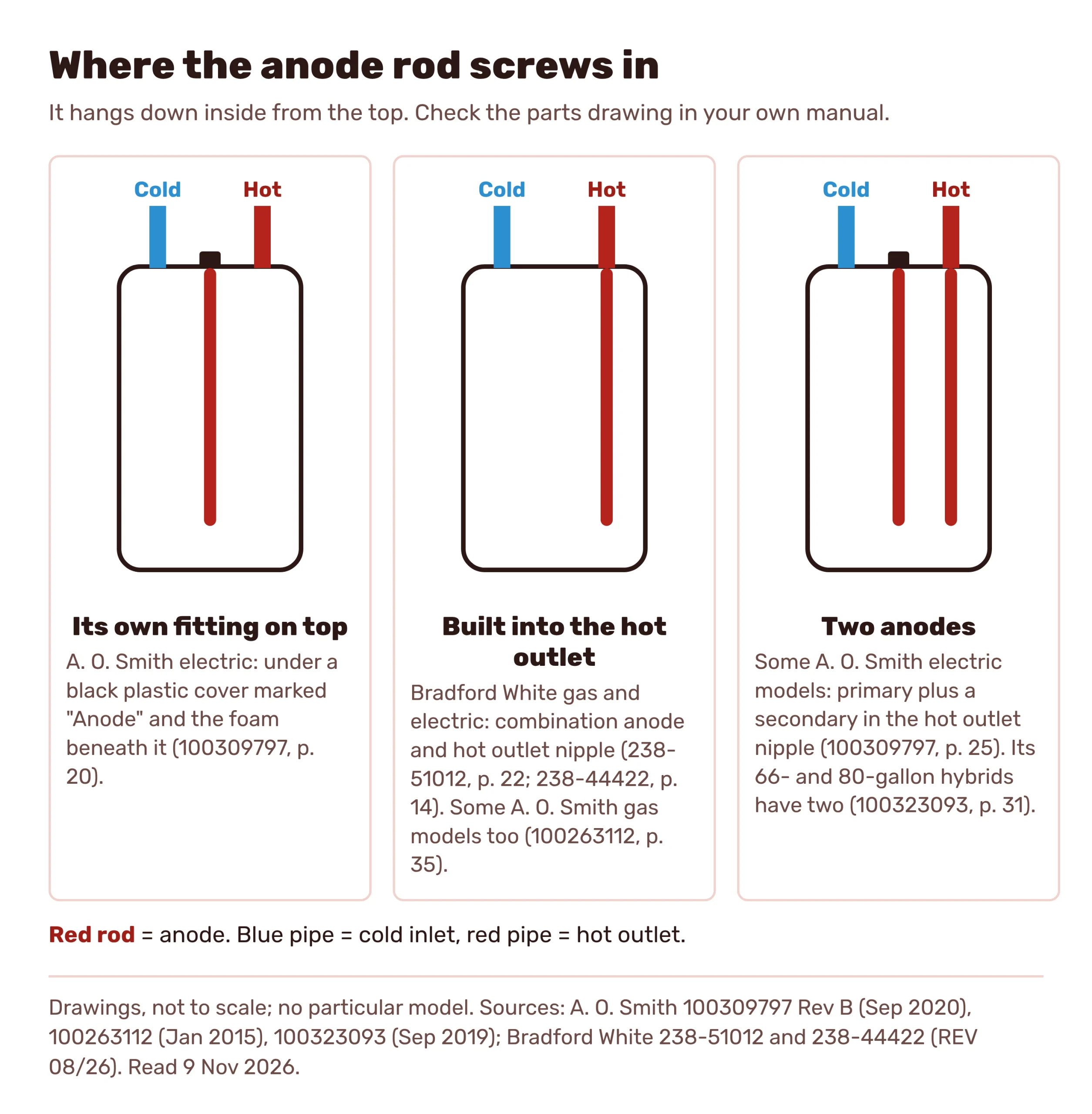
On a standard tank it hangs down inside from the top. Where exactly it screws in varies, so check the parts drawing at the back of your manual:
- Its own fitting on top. A. O. Smith’s electric guide says to find a black plastic cover marked “Anode” on top, cut away the foam insulation beneath it, and the rod’s hex head is underneath (100309797 Rev B, September 2020, p. 20).
- Built into the hot water outlet. Bradford White’s gas and electric manuals describe a combination anode rod and hot water outlet nipple (238-51012 REV 08/26, p. 22; 238-44422 REV 08/26, p. 14). A. O. Smith’s gas parts list shows a combination heat trap nipple and anode on some models (100263112, p. 35).
- More than one. Some A. O. Smith electric models list a primary anode plus a secondary anode in the hot outlet nipple (100309797, p. 25). On A. O. Smith’s hybrid (heat pump) tanks, the 50-gallon models have one anode and the 66- and 80-gallon models have two (100323093, September 2019, p. 31).
Heat pump water heaters are tank heaters too, so they have anodes. A. O. Smith’s hybrid guide puts the anode check in the same routine as its electric tanks. This page doesn’t cover tankless heaters: they have no storage tank, so use the maintenance section of their own manual.
How often to check it: what each source says
The sources don’t agree, and we don’t average them. Your own heater’s manual wins.
| Source (date) | When to check | Who, in the source’s words |
|---|---|---|
| A. O. Smith gas, electric and hybrid owner guides (2015, 2020, 2019) | After the first six months, when you drain and flush; then at least once a year, more often if needed or with a softener | Owner’s routine maintenance, or “a qualified person” if you can’t do it |
| A. O. Smith gas manual 100341468 (March 2021) | After the first six months, then once a year or more often | Owner: “Remove and inspect the anode rod”; or a qualified person replaces it |
| A. O. Smith gas manual 196293-002 (December 2004) | At a minimum once a year after the warranty period | “A qualified technician” |
| Rheem gas and electric manuals (AP23698, 2023; AP17547-1, 04/15) | Removed once a year for inspection | Part of a routine program the manual says is “followed by the user” |
| Bradford White gas and electric manuals (REV 08/26) | Every 2 years; more often with softened or phosphate-treated water | Listed with the maintenance it says a qualified service technician should do |
| DOE Energy Saver (archived 1 May 2026) | Every three to four years | Not stated; it says to read your owner’s manual |
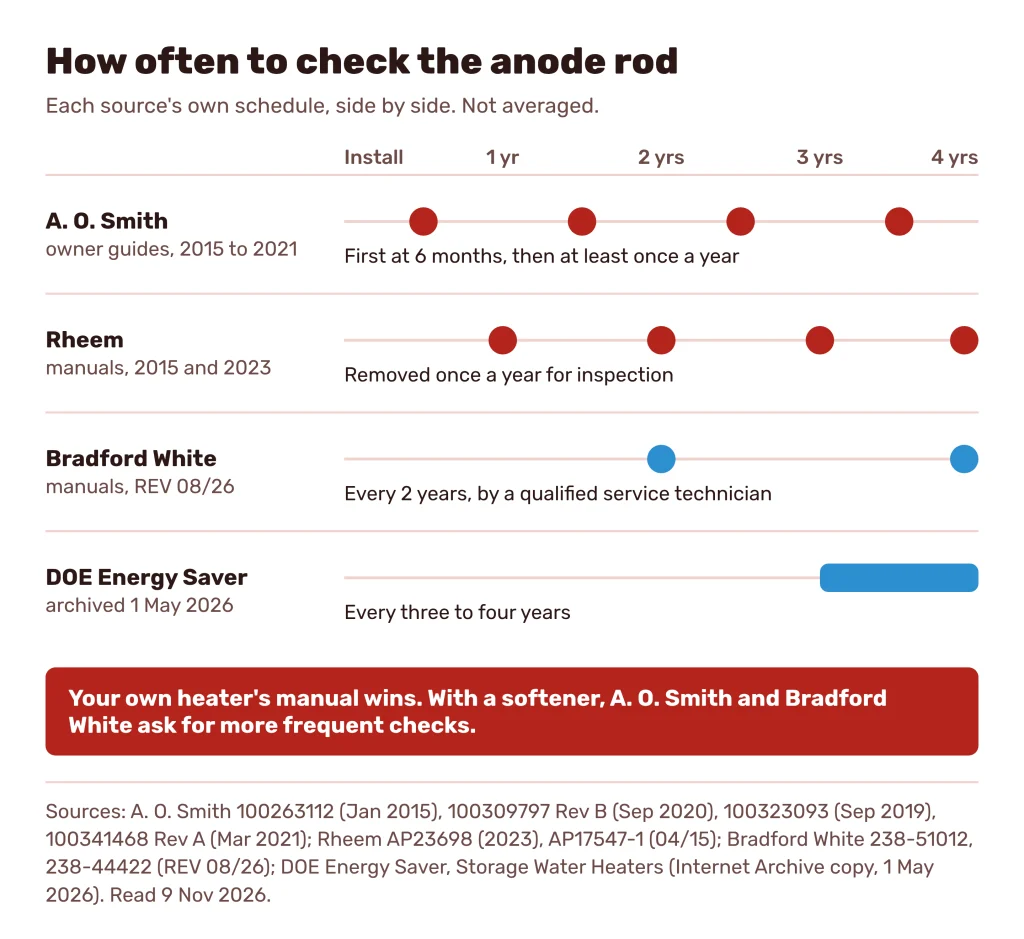
Note the split inside one company. A. O. Smith’s 2004 manual says the inspection should be done by a qualified technician. Its 2015 to 2021 guides print the job as an owner step, with “a qualified person” as the alternative. If your heater came with the older wording, that is what its maker told you.
What wears a rod out faster
- A water softener. A. O. Smith says the rod will deplete faster than normal and should be inspected more often. Bradford White says a softener may speed up anode use, and asks for more frequent checks with softened or phosphate-treated water.
- Your water’s conductivity. A. O. Smith’s 2004 manual says wear depends on how well the water conducts electricity, not necessarily on how it looks or tastes. A corroded or pitted rod points to highly conductive water and a rod that needs checking or replacing more often (196293-002, p. 20).
- Local water in general. Bradford White: water conditions in your area set how often the rod needs inspection and replacement.
That’s why a first look at six months, as A. O. Smith asks, is useful: it shows how fast your water uses up a rod, and you can set your own interval from there.
How to tell when it’s worn out
- Rheem’s measure: replace it when more than 6 inches of core wire is exposed at either end of the rod (AP23698, p. 20; AP17547-1, p. 14).
- A. O. Smith’s measure: replace it if it is substantially worn out or depleted. Its guides show three rods, from new to partly depleted to fully depleted, as the comparison (100263112, Figure 43).
- Bradford White: replace when necessary, and ask the plumbing professional who installed the heater, or Bradford White, for anode replacement information.
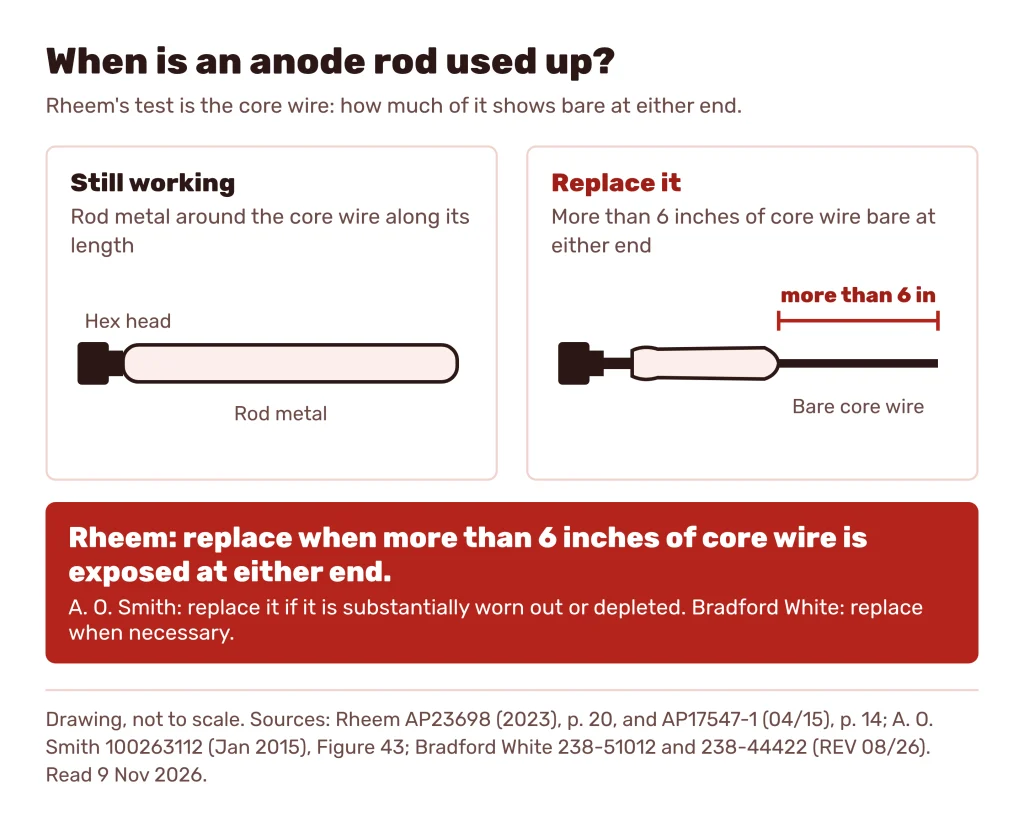
A. O. Smith’s 2004 manual adds that a corroded or pitted rod should be checked or replaced more often than one that looks intact. None of the makers’ documents we read uses a rust color in the water, or the heater’s age, as its test for the rod. If you’re working out how old the heater is, our water heater age lookup reads the serial number for the brands whose formats we could confirm.
Who should do it, and the warranty
The makers draw this line differently, so look at your own manual:
- A. O. Smith (current guides) prints owner steps. It says to get a new rod from a local plumbing supplier or have a qualified person replace it, and that if you can’t do routine maintenance yourself, you should contact a qualified person.
- Rheem puts the yearly removal in the user’s routine and says only one thing about how: turn off the cold water supply first. It gives no further steps.
- Bradford White lists the anode check with the maintenance it says a qualified service technician should do, and gives no owner steps.
Which rod. Use a replacement that matches your model. A. O. Smith’s warranty for its Voltex heat pump models applies only when the heater is used with “factory approved anode(s)” installed (100350228, September 2021), so check your own warranty sheet before fitting any other rod. A. O. Smith lists its own flexible “Universal Link Style” anodes, in magnesium and aluminum, as repair parts for its hybrid heaters (100323093, p. 31). For a rotten-egg smell, A. O. Smith lists a special zinc anode and says to contact a qualified person; Bradford White says an alternative anode can be bought from the supplier that installed the heater.
Permits. Some states and cities require a licensed plumber or gas fitter, or a permit, for work on a water heater or for gas work. Ask your building department.
How it’s replaced: electric and heat pump tanks
These steps are A. O. Smith’s, from its Residential Electric Water Heater Use & Care Guide (100309797 Rev B, September 2020, p. 20). They fit that maker’s electric tanks. Its hybrid heat pump guide (100323093, September 2019, p. 26) puts the same “remove and inspect” step in its drain routine and points to the parts drawing for the anode’s location. Its routine maintenance section adds: if you can’t do these tasks yourself, contact a qualified person (p. 20). Rheem and Bradford White give owners no steps. The cover-and-foam detail in step 5 is from the electric guide; on the hybrid, find the anode from the parts drawing. Where your heater’s label or manual differs from this, follow your heater.

- Turn the power off at the breaker (or remove the fuses). A. O. Smith’s element section adds: check the power wires with a non-contact circuit tester to make sure power is off.
- Run hot water until it’s cool. A. O. Smith’s warning: be sure the water runs cool before draining, to reduce the risk of scalding.
- Close the cold water supply valve to the heater.
- Open a hot water faucet to take the pressure off the tank.
- Uncover the rod. Remove the black plastic cover marked “Anode” on top, then cut away the foam insulation over the rod with a keyhole saw or similar tool. You don’t need to replace the foam afterwards.
- Unscrew the rod with a 1-1/16 inch socket wrench and an extension, and lift it out.
- Inspect it, and replace it if it’s depleted (see how to tell).
- Seal and refit. Apply thread sealant tape or pipe joint compound to the threads and screw the rod back in tightly.
- Turn the cold water supply back on. When hot water runs full at the open faucet, close the faucet.
- Check for leaks at the fitting and fix any you find.
- Turn the power back on. A. O. Smith’s notice: don’t turn the power on unless the tank is completely full of water. If you drained the tank, its refill step says to let a hot faucet run full for at least three minutes first, or the upper element can burn out. A. O. Smith says the tank may take two hours to heat up.
A. O. Smith places this check in the middle of its drain-and-flush routine (step 7 of 10), so many owners do both at once. Our guide to flushing a water heater covers the rest of that routine, and how often each maker says to flush.
How it’s replaced: gas tanks
These steps are A. O. Smith’s, from the drain-and-flush section of its Use & Care Guide for residential atmospheric gas heaters with the flammable vapor ignition resistant (FVIR) system, a piezo igniter and a status light (100263112, January 2015, pp. 28-29). The guide’s cover says installation and service must be performed by a qualified installer, service agency or the gas supplier, and its maintenance section says that if you can’t do these routine tasks yourself, contact a qualified person (p. 28). The anode is on the water side of the tank, so you don’t open the burner area. The gas has to be shut off and the pilot relit afterwards, though. Power-vent and direct-vent models, and heaters with electronic ignition, shut down and restart differently: follow the label and manual on your heater. Rheem gives one owner instruction (cold water off first) and Bradford White none.
- Turn the gas control knob to OFF. Use your hand only: Rheem’s and Bradford White’s lighting labels say never use tools on the knob, and if it won’t turn by hand, don’t try to repair it; call a qualified service technician.
- Turn off the manual gas valve on the heater’s supply line.
- Run hot water until it’s cool. A. O. Smith says this may take 10 minutes or longer, and warns to let the water run cool before draining, to reduce the risk of scalding.
- Connect a garden hose to the drain valve and run it to a drain, outside, or into buckets. If sediment clogs the valve and the tank won’t drain, A. O. Smith says contact a qualified person.
- Close the cold water supply valve.
- Open the drain valve, and open a hot water faucet to help the tank drain.
- Remove and inspect the anode rod with a 1-1/16 inch socket, and replace it if it’s depleted. Then screw the rod (old or new) back in: A. O. Smith’s note is that an anode must be installed at all times (p. 26).
- Flush if needed. If there was a lot of sediment, open the cold supply and let water run through until no more sediment comes out. Then close the drain valve.
- Refill completely. Open the cold supply with a hot faucet open and the drain valve closed. Let the hot faucet run full for at least three minutes, so all the air is out and the tank is full, then close it. A. O. Smith’s older manual is blunt: never turn the gas on before the tank is completely full of water (196293-002, p. 21).
- Turn the gas back on and relight by the label. A. O. Smith says to relight using the lighting instructions in its guide (p. 23) and set the temperature; a tank of cold water may take an hour or more to heat. Before lighting, A. O. Smith says to make sure the viewport (the small window for watching the flame) isn’t missing or damaged, and warns that a missing or damaged viewport must be replaced: don’t light the heater until it has been (p. 23). If the pilot won’t light or stay lit, see relighting a water heater pilot by the label, and stop where the label says to call.
A. O. Smith’s gas guide doesn’t mention thread sealant for the anode. Its 2004 manual, on a leaking anode fitting, says to drain the tank, remove the fitting, put pipe dope or Teflon tape on the threads and refit it. Use the sealant your heater’s maker names. Once the tank is full again, check the fitting for drips, as in Afterwards below.
A rod that won’t turn, or no room above the tank
None of the makers’ documents we read covers a seized rod. Every heater is connected to water pipes, and a gas heater also to a gas line and a vent. Don’t use extra leverage that could twist the heater on those connections. If the rod won’t come out with a normal socket wrench, stop, refill and restore the heater as above, and call a licensed plumber.
Headroom is the other problem. A one-piece rod has to come straight up out of the tank. On A. O. Smith’s hybrid heaters, its parts list gives anode lengths of 36 inches (50- and 66-gallon models), 42 inches (80-gallon) and a second 14-inch anode on the 66- and 80-gallon models. Those are for that model line only: your rod may be a different length. Where there isn’t room for a full rod, flexible link-style rods exist, and A. O. Smith lists its own for the hybrid line. Check that any rod you buy fits your model and keeps your warranty.
Afterwards: leaks and smells
- A drip at the rod’s fitting. A. O. Smith’s leakage checkpoints list the anode fitting as one place water can come from. Its check: push a cotton swab between the jacket opening and the fitting; if the swab comes out wet, the threads are leaking (196293-002, p. 21). If you can’t trace the water, our guide to a leaking water heater goes spot by spot.
- A smell. A. O. Smith’s 2004 manual says the rotten-egg smell needs four things at once: sulfate in the water, little dissolved oxygen, a harmless sulfate-reducing bacteria in the tank, and excess hydrogen from the anode’s protective action. Don’t take the rod out to fix it: as above, that ends the tank warranty with all three makers.
- Log it. A. O. Smith’s guides have a “Maintenance performed” box on page 3. Write the date and what the rod looked like. Next year’s check is easier with that to compare against.
Your next step
- Find your manual. Read the model number off the rating plate on the side of the heater and look up that model’s manual on the maker’s own website. Check its maintenance section for the anode interval, who it says should do the job, and where the rod is.
- Read your warranty sheet before buying a replacement rod, especially a non-factory or link-style one.
- Plan it with a flush, as A. O. Smith does, so the cold supply only goes off once.
- Call a licensed plumber if your manual reserves the job for a technician, if the rod won’t turn, if there’s no room to lift it out, or if you’re not comfortable shutting off and relighting a gas heater.
- What can’t wait: a gas smell (leave and call from outside), a CO alarm, a relief valve running continuously, water leaking from the tank body, or a heater that has been under water.
Sources checked on 9 November 2026: A. O. Smith documents 100263112 (January 2015), 100309797 Rev B (September 2020), 100323093 (September 2019), 100350228 (September 2021), 100341468 Rev A (March 2021, a maker PDF hosted on A. O. Smith’s retail partner site) and 196293-002 (printed December 2004); Rheem AP23698 (file dated July 2023) and AP17547-1 (04/15); Bradford White 238-51012 and 238-44422 (REV 08/26); DOE Energy Saver (archived 1 May 2026); PHMSA; CDC (reviewed 26 October 2026); CPSC.
Sources
- A. O. Smith: Installation Instructions and Use & Care Guide, Residential Atmospheric Gas Water Heater with FVIR, 100263112 (January 2015), cover, pp. 3, 23, 26, 28-29, 35
- A. O. Smith: Installation Instructions and Use & Care Guide, Residential Electric Water Heater, 100309797 Rev B (September 2020), pp. 3, 19-21, 25
- A. O. Smith: Residential Hybrid Electric Heat Pump Water Heater Use and Care Guide, 100323093 (September 2019), pp. 3, 23, 26, 31
- A. O. Smith: Residential Electric Warranty (Voltex heat pump models), 100350228 (September 2021)
- A. O. Smith: Installation Instructions and Use & Care Guide, Residential Gas Water Heaters (Signature 100), 100341468 Rev A (March 2021), pp. 4, 27, 29 (maker PDF hosted on A. O. Smith's retail partner site)
- A. O. Smith: Instruction Manual, Residential Gas Water Heaters, 196293-002 (printed 12/04), pp. 18, 20, 21
- Rheem: Use & Care Manual, Residential Gas, Low NOx, AP23698 (file dated July 2023), pp. 20-21
- Rheem: Use & Care Manual, Electric Residential Water Heaters, AP17547-1 (04/15), pp. 14-15
- Bradford White: Installation and Operation Manual, Gas-Fired Water Heaters with FVIR, 238-51012-00V REV 08/26, pp. 5, 21-22
- Bradford White: Installation and Operation Manual, Electric Water Heater, 238-44422 REV 08/26, pp. 3, 14
- DOE Energy Saver: Storage Water Heaters (Internet Archive copy, 1 May 2026; live page returns not found)
- PHMSA: Recognizing and Responding to Natural Gas Emergencies in Your Home or Workplace
- CDC: Carbon Monoxide Poisoning Basics (reviewed 26 October 2026)
- CPSC: Carbon Monoxide Information Center