To flush a tank water heater, you cool the water down, turn off the gas or the power, close the cold water supply, drain the tank through its drain valve with a garden hose, then let cold water run through the open drain until no more sediment comes out. Then you refill the tank all the way, with a hot tap running, before the gas or power goes back on. The steps differ a little between gas, electric, power-vent and heat pump models, so this page follows the maker’s manual for each kind and says whose manual each step comes from. It is one of our water heater maintenance guides.
How often is where the sources disagree. A. O. Smith says drain and flush after the first six months and then at least once a year. Rheem suggests draining a few quarts every month, and Bradford White a gallon a month. The Department of Energy’s archived advice is a quart every three months. All four are set out side by side below; the manual for your own model is the one to follow.
General information, not professional advice. Gas, 240-volt power, scalding water and a pressurised tank can hurt you. Follow the label and manual on your own heater; where they say to stop and call a qualified technician, stop. Codes and licensing rules are set locally.
Read this first: gas smell, carbon monoxide, flooding, burns
- If you smell gas, don’t start. PHMSA, the federal pipeline regulator, says not to strike a match or make a flame, use a phone or cell phone, start an engine, or turn any light, switch or garage door opener on or off. Leave the area and call 911 from a neighbor’s house or somewhere well away from the leak (PHMSA, natural gas emergencies). The makers’ manuals add: don’t try to light any appliance, call your gas supplier from a neighbor’s phone, or the fire department if you can’t reach the supplier; Rheem adds that you shouldn’t return home until the gas supplier or fire department says so (Rheem manual AP23698, cover).
- Carbon monoxide. A. O. Smith’s manual calls CO a colorless, odorless gas made by burning fuel (100263112, p. 6). CDC lists headache, dizziness, weakness, upset stomach, vomiting, chest pain and confusion as the common symptoms, and warns that people who are asleep can die before they notice any (CDC, CO poisoning basics). If you suspect CO, CPSC says get outside to fresh air at once, then call 911, and it advises CO alarms on every level of the home and outside sleeping areas (CPSC CO center). More on alarms and back-drafting: gas smell or carbon monoxide near a water heater.
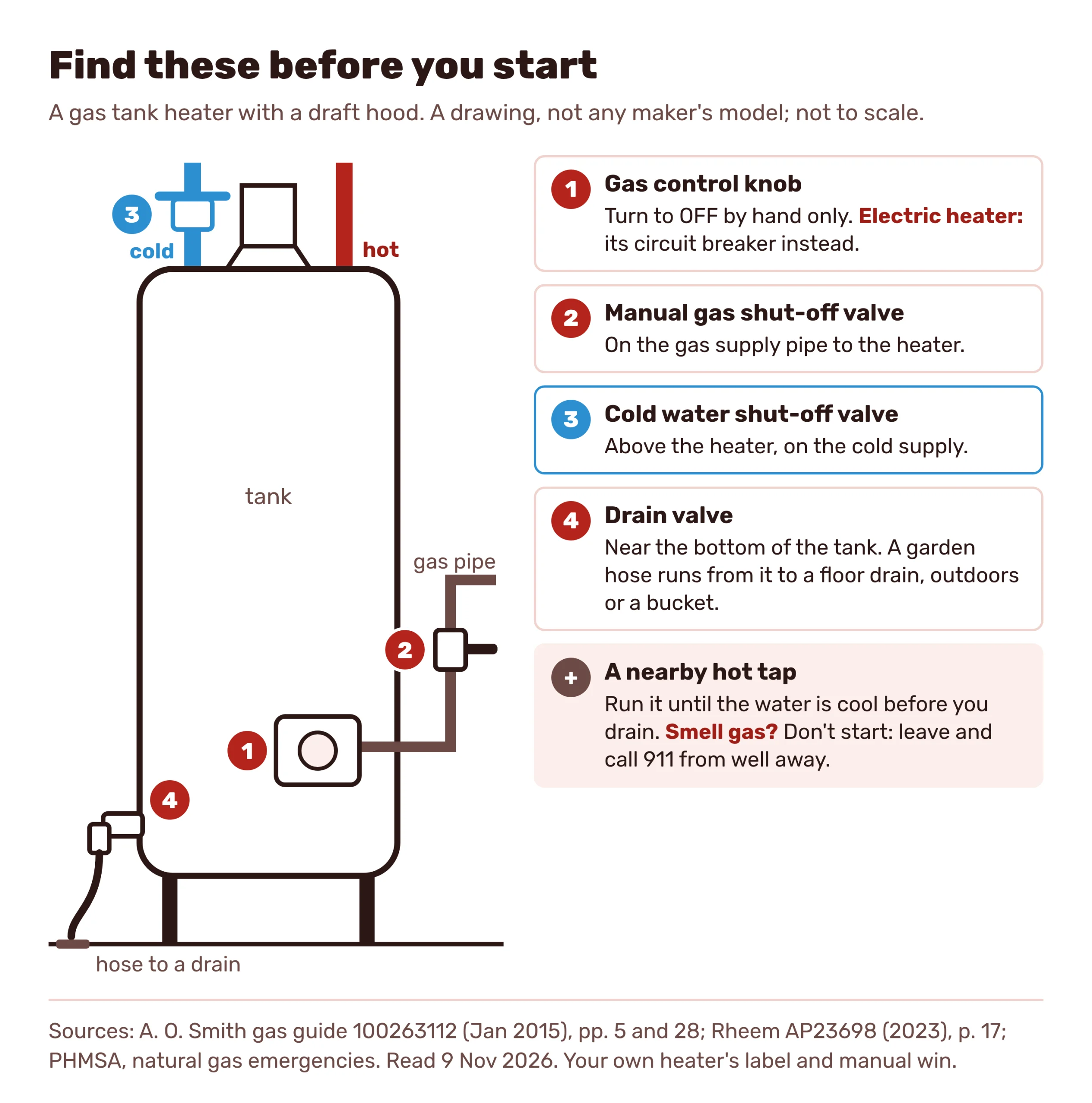
- Shut-off. Know where three things are before you begin: the gas control knob (or, on an electric heater, its circuit breaker), the manual gas shut-off valve on the supply pipe, and the cold water shut-off valve above the heater. When you relight, wait the time your heater’s lighting label gives after turning the knob to OFF. If the burner won’t shut off or the heater overheats, A. O. Smith says turn off the manual gas supply valve and call a qualified person (A. O. Smith 100263112, p. 5).
- A heater that has been under water. Don’t flush it, relight it or turn its power back on. A. O. Smith says a heater that has been through flood conditions, or whose thermostat has been under water, must be replaced (100263112, p. 5). Rheem’s lighting label says not to use the heater if any part has been under water and to have a qualified installer or service agency replace it (AP23698, p. 17). Bradford White says not to use it if any external part has been under water, and to have a qualified service technician inspect it and replace any part of the control system that was under water (Bradford White 238-51012, p. 4).
- Burns. The water that comes out of the drain valve can be scalding. CPSC says most adults get third-degree burns from 150°F water in 2 seconds, 140°F in 6 seconds and 130°F in 30 seconds, and that even 120°F can do it in 5 minutes (CPSC Publication 5098). That is why A. O. Smith’s manuals have you run the hot water until it’s cool before you open the drain, and Rheem warns that drained water may be hot enough to scald (AP23698, p. 20).
How often to flush: what each source says
There is no single right interval. The makers write different schedules, and the federal advice differs again. Here they are as written, with each document’s date.
| Source | How often | How much |
|---|---|---|
| A. O. Smith gas manual 100263112 (January 2015), p. 28 | After the first six months, to see how much sediment builds up; then once a year if there was little, more often if there was a lot | Drain the tank, then flush until no more sediment comes out |
| A. O. Smith electric manual 100309797 Rev B (September 2020), p. 20 | After the first six months; then at least once a year, or more often, depending on water hardness | Same |
| A. O. Smith heat pump (hybrid) manual 100379656 (May 2024), pp. 3 and 32 | After the first six months; then at least once a year, or more often, depending on water hardness | Same; the same schedule also has you clean the air filter and condensate pan |
| A. O. Smith power-vent manual 100348176 (printed May 2025), p. 57 | Every 6 months | Flush under water pressure until the water runs clean |
| Rheem gas manual AP23698 (2023), p. 20, and electric manual AP17547-1 (April 2015), p. 14 | Every month | “A few quarts” |
| Bradford White gas manual 238-51012 and electric manual 238-44422 (both REV 08/26) | Every month | “A gallon”; the electric manual also says to drain at least once a month until the water runs clear |
| Department of Energy, Energy Saver (archived copy, 1 May 2026) | Every three months | “A quart” |
| CDC, Preventing Waterborne Germs at Home (page dated 15 March 2024) | Says many makers recommend once a year, and also before you move into a home, after plumbing work, and if the tap water is discolored | Follow the maker’s instructions or have a professional do it |
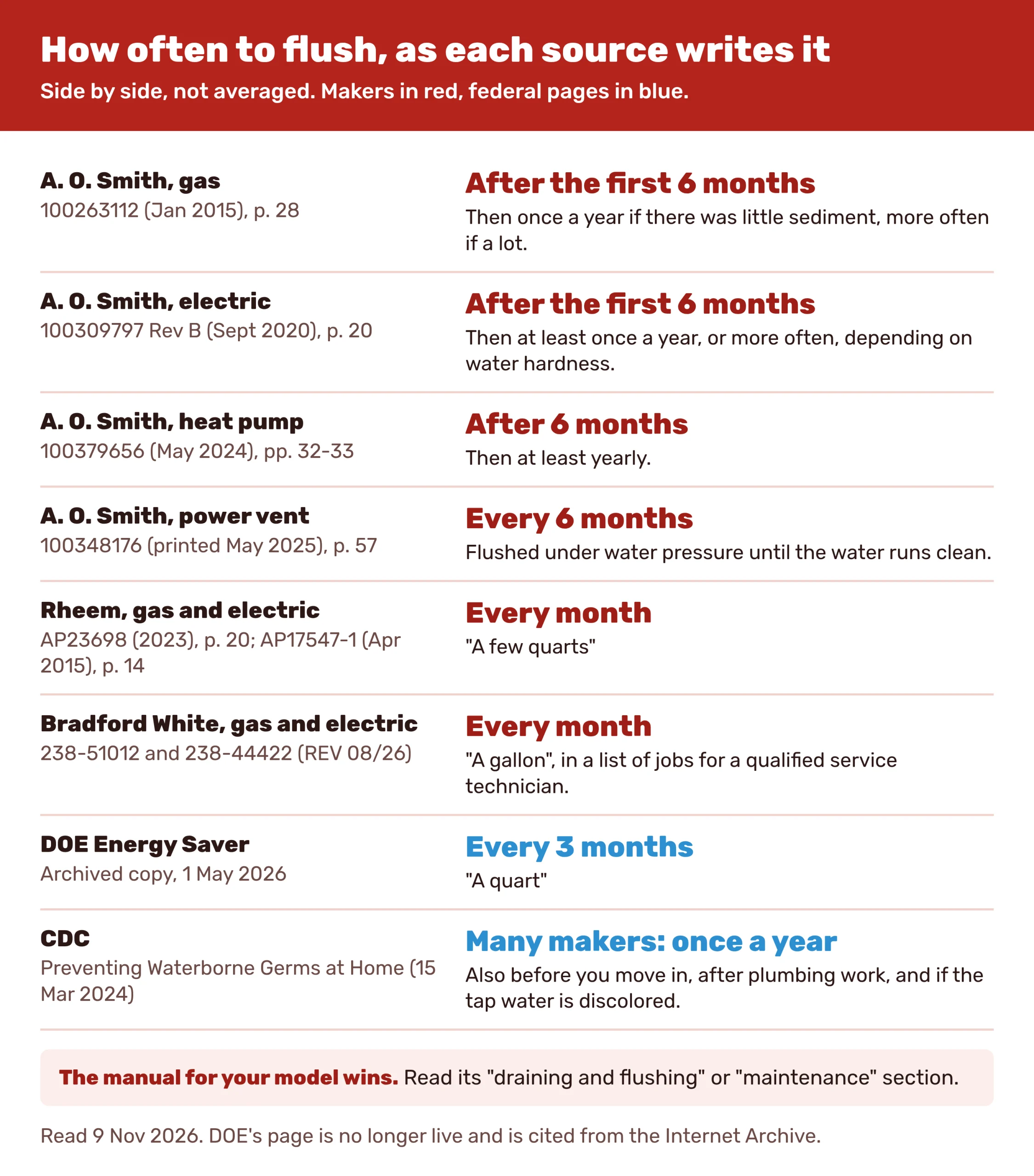
Three things are worth knowing about this table. First, the Energy Saver page is no longer live: energy.gov’s storage water heater page returned a 404 when we checked on 9 November 2026, so the quote comes from the Internet Archive copy of 1 May 2026, which says routine maintenance “may include” it and tells readers to check the owner’s manual. Second, Bradford White lists its monthly gallon in a list of jobs it says “should be performed by a qualified service technician” (238-51012, pp. 21-22; 238-44422, p. 14). The electric manual’s maintenance page also says, just before that list, to drain the heater at least once a month through the drain valve until the water runs clear. Third, A. O. Smith’s schedule depends on what you find: the first flush at six months is how you learn whether your water leaves a little sediment or a lot.
Why it matters, in the makers’ words: minerals in tap water settle on the tank bottom, the amount depends on how hard the water is and how hot the tank is set, and draining it extends the life of the heater (A. O. Smith 100263112, p. 28). A. O. Smith adds that sediment can reduce efficiency and heavy deposits can damage the heater (p. 26).
Before you start: check what kind of heater you have
Look at the rating plate (the label on the side of the tank) and the lighting label. They tell you the fuel, the model number and how the heater lights. Find the manual for that model number on the maker’s own website and keep it open next to you. Flushing is a partial or full drain plus a rinse; to empty a tank and leave it empty, for a vacation house in freezing weather for example, see how to drain a water heater. The label and manual on your heater win wherever they differ from the steps on this page.
- Gas, with a draft hood on top (an atmospheric heater). The models in the manuals below have a pilot lit by a push-button igniter and a sealed burner chamber with a sight glass, a flammable vapor ignition resistant (FVIR) design. Follow the gas steps below. If yours has a pilot you light by hand with a match, or anything else that doesn’t match, go by its own label.
- Gas, with a blower on top and an electrical connection (power vent or power direct vent). The model we read lights with a direct spark, with no pilot to relight. See the power-vent section.
- Electric, with one or two access panels on the side and no vent. See the electric steps.
- Heat pump (hybrid), with a fan and coil unit on top of the tank. See the heat pump section.
- Tankless, a box on the wall with no tank. Tankless makers give a different job: Rinnai’s N series manual (100000467, June 2020), for example, has the scale flushed out by pumping vinegar through the heater. See tankless water heater maintenance and descaling.
What the manuals have you use: a garden hose that reaches a floor drain, the outdoors or a bucket, and a way to get to the cold supply valve and a nearby hot tap (A. O. Smith 100263112, p. 28). Bradford White’s electric drain valve opens with a flat-head screwdriver in a slot, and some of its electric models have no drain valve at all (238-44422, pp. 4 and 12): on those, the manual’s method is to disconnect the cold inlet piping, which is plumbing work, so check your manual first.
How to flush a gas tank water heater
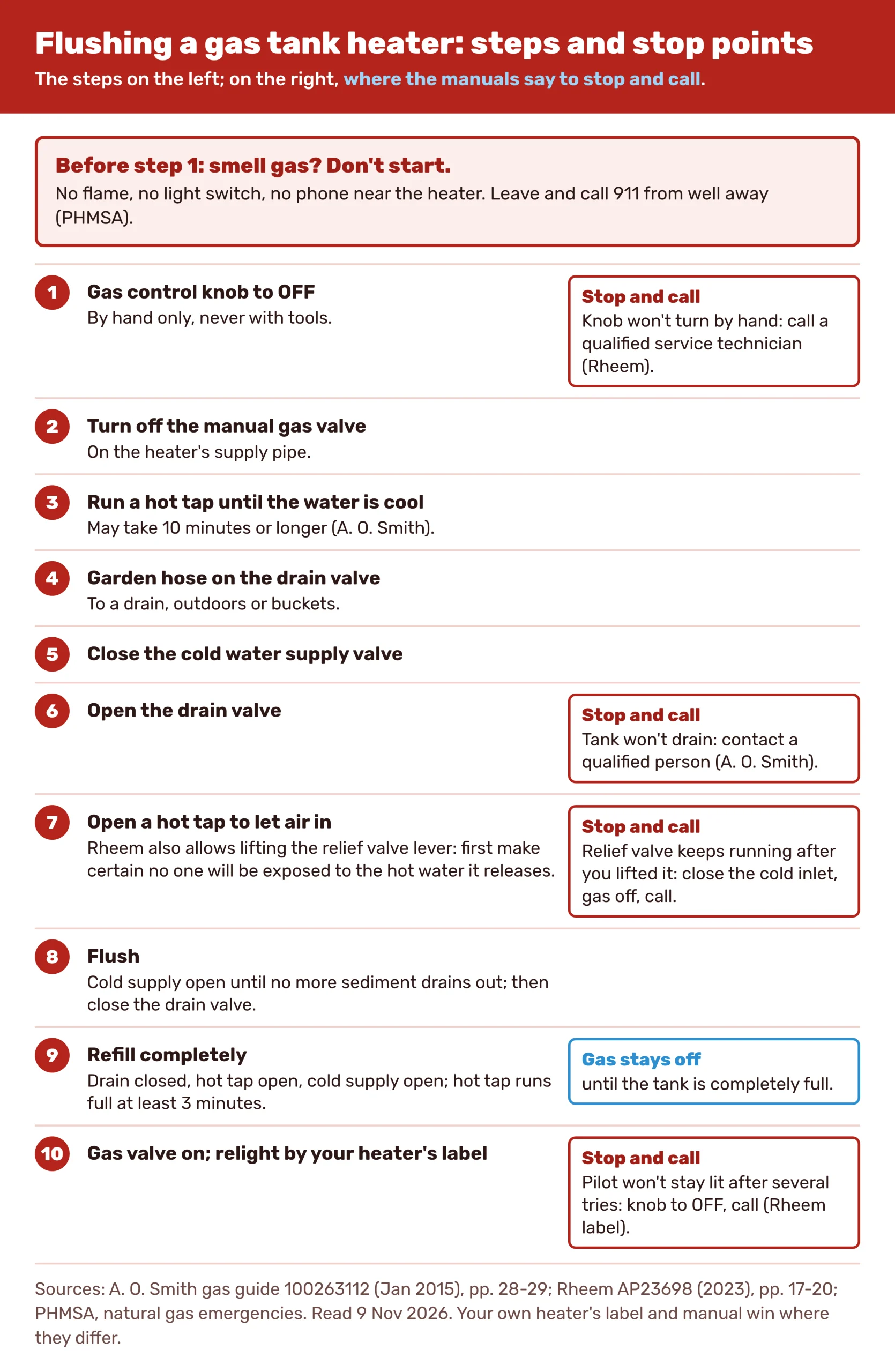
These steps follow A. O. Smith’s owner’s guide for its atmospheric gas heater with an FVIR burner, a push-button igniter and a status light (Installation Instructions and Use & Care Guide 100263112, January 2015, pp. 28-29). Notes in each step say where Rheem’s (AP23698) and Bradford White’s (238-51012 REV 08/26) gas manuals differ. Flushing works on the water side only: you don’t open the burner chamber or touch any gas fitting. A. O. Smith’s guide says that if you can’t do its routine maintenance tasks, contact a qualified person.
- Turn the gas control knob to OFF. Bradford White first turns the temperature dial to its lowest setting, then (on its White Rodgers mechanical control) pushes the knob in slightly and turns it to OFF (238-51012, p. 14). Turn the knob by hand only; the lighting labels say never to use tools, and if the knob won’t turn by hand, don’t try to repair it: call a qualified service technician (Rheem AP23698, p. 17).
- Turn off the manual gas valve on the heater’s supply pipe. Rheem’s manual says to shut off the gas at the gas control or the manual shut-off valve before draining (AP23698, p. 20); A. O. Smith and Bradford White have you do both.
- Open a hot water tap and let it run until the water is cool. A. O. Smith says this may take 10 minutes or longer, and warns to make sure the water runs cool before draining, to reduce the risk of scalding.
- Connect a garden hose to the drain valve near the bottom of the tank and put the other end in a drain, outside, or in buckets. Rheem says the drained water may be hot enough to scald and should go to a suitable drain.
- Close the cold water supply valve.
- Open the drain valve. A. O. Smith notes that sediment may clog the valve and stop it draining. Stop here if it won’t drain: the manual says if you can’t get the tank to drain, contact a qualified person.
- Open a hot water tap so air can get in and the tank drains faster. Rheem also allows lifting the relief valve lever to let air in; if you do, its manual says first make certain no one will be exposed to the hot water the valve releases (AP23698, p. 20). If the relief valve won’t stop running afterwards, see the stop list below.
- Flush. If a lot of sediment came out, A. O. Smith says flush the tank by opening the cold water supply valve and letting the water run through until no more sediment drains out. Then close the drain valve.
- Refill the tank completely. Make sure the drain valve is closed and a hot tap is open, then open the cold supply valve. A. O. Smith says let the hot tap run full for at least three minutes so all the air is out and the tank is completely full, then close the tap. Bradford White’s test is a steady stream from several hot taps, then check the drain valve, the relief valve and the pipe connections for leaks (238-51012, p. 14). Rheem’s precautions say don’t turn the heater on unless it is completely filled with water, or if the cold supply valve is closed (AP23698, p. 18). A. O. Smith’s lighting instructions also begin by making sure the tank is completely filled (100263112, p. 23).
- Turn the manual gas valve back on and relight by the label (next section), then set the knob to the temperature you want. A. O. Smith says a tank of cold water may take an hour or more to heat.
Relighting after the flush
Follow the lighting label on your own heater: igniter, knob positions and wait times differ by maker and control. What the three gas manuals say, in short:
- Before lighting, smell all around the heater for gas, including next to the floor, because some gas is heavier than air. If you smell gas, stop and follow the gas-smell steps above (Rheem AP23698 label, p. 17).
- Rheem’s piezo label: knob to OFF, wait five minutes to clear any gas (if you smell gas, stop), don’t remove the inner door or try to light the pilot by hand; turn the knob to PILOT, hold it all the way in and press the igniter button several times until the status light blinks, check the pilot flame through the sight glass, replace the outer door, then release the knob. If the pilot won’t stay lit after several tries, turn the knob to OFF and call your service technician or gas supplier. If the knob doesn’t pop back out when released, stop and call at once.
- A. O. Smith’s status-light model: make sure the tank is completely full and the manual gas valve is on, turn the knob to PILOT, press it fully in and hold it while clicking the igniter about once a second for up to 90 seconds, until the status light flashes; then release the knob. No flashing after 90 seconds: release the knob and wait 10 minutes before trying again. After three attempts, turn the knob to OFF and go to the manual’s troubleshooting section (100263112, p. 23). Replace the viewport if its glass is missing or damaged before lighting.
- Bradford White: wait at least 2 minutes after the control is pressurized with gas before you try to light the pilot or push the igniter (238-51012, p. 14).
The full relighting steps, label by label, are on relighting a water heater pilot light. Once it’s running, A. O. Smith’s annual owner checks include looking at the burner flame through the viewport (it should be soft blue, not all yellow) and, after lighting, a draft test at the draft hood. A flame that doesn’t look right means contacting a qualified technician; a failed draft test means shutting off the gas and not using the heater until a qualified person has checked the vent and air supply (100263112, pp. 23-24 and 29).
How to flush an electric water heater
These steps follow A. O. Smith’s electric owner’s guide (Installation Instructions and Use & Care Guide 100309797 Rev B, September 2020, pp. 20-21). The one rule all three electric manuals share: the power stays off until the tank is completely full again. If the elements are powered with no water around them, they burn out (“dry fire”); Bradford White says element failure from dry-firing is not covered by its warranty (238-44422, p. 12), and Rheem says the same for operation with an empty or partly empty tank (Rheem AP17547-1, p. 7).
- Turn the heater’s circuit breaker OFF (or remove its fuses). Bradford White’s manual says to disconnect the power supply and to consult a plumbing professional or the electric company for service (Bradford White 238-44422, p. 12).
- Run a hot tap until the water is cool. A. O. Smith’s warning: make sure the water runs cool before draining, to reduce the risk of scalding.
- Connect a garden hose to the drain valve and run it to a drain, outside or into buckets.
- Close the cold water supply valve.
- Open the drain valve, then open a hot tap so the tank drains faster. If sediment has formed masses that stop the tank draining, A. O. Smith says to have a qualified person remove it with a de-liming agent suitable for drinking water.
- Flush. If sediment came out, open the cold supply valve and let water run through until no more sediment drains out, then close the drain valve.
- Refill: drain valve closed, a hot tap open, cold supply open. Let the hot tap run full for at least three minutes; A. O. Smith says skipping this can burn out the upper element. Close the tap once the tank is completely full. Bradford White’s fill steps end with checking the drain valve, relief valve and pipe connections for leaks (238-44422, p. 12).
- Turn the breaker back on. A. O. Smith says the tank may take two hours to heat.
A. O. Smith’s electric guide also says that in very hard water you should take out and check the elements whenever you drain the tank, and that it is often easier and cheaper to replace lime-crusted elements than to clean them. It gives owners those steps, and opens them by saying that anyone not comfortable replacing an element or thermostat should have a qualified person do it. Rheem and Bradford White tell owners not to attempt repairs to elements, thermostats or wiring (Rheem AP17547-1, p. 16; Bradford White 238-44422, p. 13). The same A. O. Smith flush is when it suggests inspecting the anode rod: see when to check the anode rod.
Power-vent and heat pump models
Power-vent gas heaters work differently. A. O. Smith’s manual for its power vent and power direct vent models with direct spark ignition (100348176, printed May 2025, pp. 57-58) calls for draining and flushing every 6 months, and its flush keeps the cold supply open: the tank is flushed under system water pressure. In outline: turn off the electrical supply at the breaker; run a nearby hot tap until the water is no longer hot, then close it; secure the hose to the drain valve before and during the flush; open the drain valve and let water flow until it runs clean; close the valve and remove the hose; refill per the manual; turn the power back on and let the heater run several heating cycles. The manual’s warnings at this step: burn hazard, hot water discharge, keep hands clear of the drain valve discharge. The flushing steps don’t turn the gas off; the manual’s separate draining steps turn it off at the main shut-off only if the heater will be shut down for a long time (p. 57). Its filling rule: water must flow from the hot tap before the gas is turned on (p. 40).
Be aware of how that manual frames its work. It says installation and service need skills equal to a qualified agency, and that if you are not qualified, and licensed or certified where your local authority requires it, you should not attempt any of its procedures (p. 8). Its maintenance schedule lists the 6-month flush, but the manual does not set flushing apart as an owner task. If your heater is a power-vent model, read its own manual before deciding who does it.
Heat pump (hybrid) tanks drain like electric ones. A. O. Smith’s hybrid guide (Installation Instructions and Use & Care Guide 100379656, May 2024, pp. 32-33) uses the same breaker-off, cool-down, drain, flush and three-minute refill steps, and the same interval: after six months, then at least yearly. It adds that the unit has dry-fire protection but you should still fill the tank before power goes on, and that failing to do the required or recommended maintenance may void the warranty. Its schedule also has you clean the air filter and condensate pan at the same times.
When to stop and call a qualified technician
- The tank won’t drain, or sediment has formed masses (A. O. Smith).
- The gas knob won’t turn by hand, won’t pop back out, or the pilot won’t stay lit after several tries (Rheem, A. O. Smith labels).
- The relief valve keeps running after you lifted the lever: close the cold inlet, turn off the gas or power, and call. A. O. Smith’s power-vent manual says to close the cold inlet at once, drain the heater and replace the valve with a correctly rated one (100348176, p. 60). Never plug or cap a relief valve.
- Water seems to come from the tank itself rather than a fitting or the drain valve. Work out where it’s coming from first: what the leak’s location tells you.
- The burner flame looks wrong or the draft test fails after relighting (A. O. Smith 100263112, pp. 24 and 29).
- Anything looks different from your heater’s label or manual.
Flushing is plumbing on the water side. Work on the gas side (the gas control, burner, gas line or vent) is a separate matter: the makers reserve most of it for qualified service people, and some states and cities require a licensed gas fitter or a permit for gas work, so ask your building department. CDC also advises having a gas water heater serviced by a qualified technician every year (CDC), and Bradford White says its heaters should be inspected at least annually by a qualified service technician (238-51012, p. 21).
What flushing does and doesn’t fix
- Less hot water than before. A. O. Smith lists sediment or lime on the tank bottom as one cause, alongside a faulty mixing valve, an undersized heater, a melted dip tube and plumbing leaks (100263112, pp. 25-26).
- Rumbling. Rheem’s troubleshooting chart links it to scale and sediment (AP23698, p. 23). Other sounds have other causes: see what each water heater noise means.
- Discolored water or after plumbing work. CDC lists both as times many makers recommend a flush (CDC).
- A rotten-egg smell usually isn’t sediment. A. O. Smith puts it down to harmless bacteria multiplying in the tank, says a special zinc anode may help and to contact a qualified person, and says an anode must stay installed or the warranty is void (100263112, p. 26).
- A dripping relief valve usually means the home’s water pressure is too high or there is no thermal expansion tank, not sediment (A. O. Smith 100263112, pp. 26 and 29).
Your next step
Read the rating plate on your heater for the maker, model number and fuel, then find that model’s manual on the maker’s own site and look for its “draining and flushing” or “maintenance” section. That tells you which interval and which steps apply to you. If you smell gas at any point, leave and call 911 or your gas utility from outside. If the drain valve won’t open or close properly, or anything leaks from the tank itself, close the cold supply, turn off the gas or power, and call a licensed plumber.
Sources checked on 9 November 2026: A. O. Smith manuals 100263112 (Jan 2015), 100309797 Rev B (Sept 2020), 100348176 (printed 05/25) and 100379656 (May 2024); Rheem AP23698 and AP17547-1 (04/15); Bradford White 238-51012 and 238-44422 (REV 08/26); CPSC Publication 5098; CDC; PHMSA; the Department of Energy’s Energy Saver page (Internet Archive copy, 1 May 2026).
Sources
- A. O. Smith, Installation Instructions and Use & Care Guide, Residential Atmospheric Gas Water Heater with FVIR, 100263112 (January 2015)
- A. O. Smith, Installation Instructions and Use & Care Guide, Residential Electric Water Heater, 100309797 Rev B (September 2020)
- A. O. Smith, Instruction Manual, Power Vent / Power Direct Vent Gas Models, 100348176 (printed 05/25)
- A. O. Smith, Installation Instructions and Use & Care Guide, Hybrid Electric Heat Pump Water Heater, 100379656 (May 2024)
- Rheem, Use & Care Manual, Residential Gas Low NOx FVIR, AP23698 (2023)
- Rheem, Use & Care Manual, Electric Residential, AP17547-1 (04/15)
- Bradford White, Installation and Operation Manual, Gas-Fired Water Heater with FVIR, 238-51012-00V (REV 08/26)
- Bradford White, Installation and Operation Manual, Electric Water Heater, 238-44422 (REV 08/26)
- Rinnai, Residential Tankless Installation and Operation Manual, N series, 100000467 (6/2020)
- DOE Energy Saver, Storage Water Heaters (Internet Archive copy, 1 May 2026)
- CDC, Preventing Waterborne Germs at Home
- CDC, Carbon Monoxide Poisoning Basics
- CPSC, Carbon Monoxide Information Center
- CPSC Publication 5098, Avoiding Tap Water Scalds
- PHMSA, Recognizing and Responding to Natural Gas Emergencies