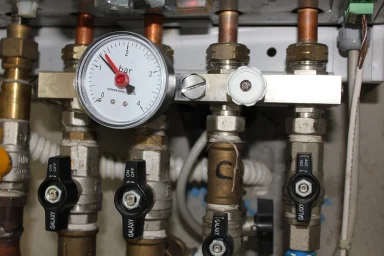
Most water heater problems show up as one of five things: water where it shouldn’t be, no hot water or not enough, a gas pilot that’s out, a noise, or a smell. Each points to a short list of causes that the makers’ own manuals name. Start with your symptom, follow its guide, and stop where the label or manual on your heater says to call a qualified technician.
General information, not professional advice. Gas, 240-volt power, scalding water and a pressurised tank can hurt you. Follow the label and manual on your own heater; where they say to stop and call a qualified technician, stop. Codes and licensing rules are set locally.
Before anything else: gas, carbon monoxide and floods
- If you smell gas, don’t look for the cause and don’t try to relight anything. PHMSA, the federal pipeline safety agency, says not to make any flame, start an engine, use a phone or turn any switch on or off. Leave the area and call 911 from a neighbor’s house or somewhere well away from the smell. Don’t go back in until the gas supplier or fire department says you can.
- If a carbon monoxide (CO) alarm sounds, or anyone has a headache, dizziness, weakness, nausea, vomiting, sleepiness or confusion, CPSC says to get outside to fresh air immediately and then call 911.
- If any part of the heater has been under water, don’t relight it, switch it on or repair it. The makers’ manuals say a flooded heater is replaced, or inspected by a qualified service technician who replaces every part of the controls that was under water.
- If the relief valve is sending out a steady stream of very hot water, keep everyone away from the end of its pipe, turn the gas or power off and call a qualified person. Never cap or plug the valve.
More on the warning signs, CO alarms and who fixes what: gas smell or carbon monoxide near a water heater.
We recommend no plumbers or products. Every step in the guides below comes from the maker’s own manual or label, named with its part number and date, or from a federal agency.
First: which heater, and is it the whole house?
The rating plate gives the fuel, model and serial number. Gas tank, electric tank, tankless and heat pump (hybrid) heaters fail differently, so most guides here split their checks by type, and the model number finds your manual on the maker’s site.
No hot water at one tap can be a failed mixing valve in that shower, not the heater. Water on the floor can be a fitting or condensation, not the tank.
Water around the heater
A. O. Smith’s 2004 gas manual says “many suspected ‘Leakers’ are not leaking tanks” (A. O. Smith 196293-002, printed 12/04, p. 21). Where the water starts tells you which kind of leak you have.
- Start with water heater leaking: what the leak’s location tells you. It goes through the four spots in order: on top (pipe connections or condensation), at the relief valve or its pipe (usually pressure), at the drain valve (the valve or its thread), and under the tank.
- If the water is pooling at the base, read water heater leaking from the bottom. It works from the outside in: the drain valve, the relief valve pipe, condensation inside a gas heater just filled with cold water, a joint higher up, and on electric heaters the lower element.
- If the drip comes from the valve with the small lever near the top, read relief valve dripping or leaking. A. O. Smith’s gas and electric manuals say an occasional drip usually means water pressure that is too high or a system that needs a thermal expansion tank, not a failed valve. A steady stream of very hot water is a different problem, covered at the top of that guide.
If the water really is coming from the steel tank, none of the makers’ manuals we read repairs it: the heater is replaced. That is also why A. O. Smith asks for a drain pan wherever a leak would cause damage, since in its words the tank will eventually leak.
No hot water, or not enough
Read no hot water: a step-by-step check first. It confirms whether it’s one tap or the whole house, then branches by heater: on a gas tank the makers point first at the pilot and the gas supply; on an electric tank, the breaker and the reset button; a heat pump heater may be in the wrong mode; a gas tankless unit may see too little flow or show a code.
Two guides go deeper on electric tanks:
- Electric water heater not heating follows A. O. Smith’s order: power, the upper element, then the reset button, then the upper thermostat or its wiring. Water that is only lukewarm or runs out early points more often to the lower element or lower thermostat, thermostats set too low, or a heater too small for the demand. Every step starts with the breaker off.
- The water heater reset button explains the red button on the upper thermostat. It belongs to the high-limit switch (the ECO, or energy cut-off), which cuts power to the elements when the water gets too hot. The makers treat a trip as a fault to find, not something to keep pressing. Gas heaters work differently: on the controls we read, the high-temperature shut-off is either not resettable at all or, on some electronic controls, cleared by a step Bradford White reserves for qualified service providers.
Gas heaters: the pilot
Read these two in order.
- Water heater pilot light: relighting it by the label. There is no single method. Older heaters have a pilot you light by hand; many newer ones have a push-button igniter and a sealed burner chamber, often with a status light; power-vent and direct-vent models may have no pilot at all, and their labels say never to light the burner by hand.
- Pilot light won’t stay lit or keeps going out. A pilot that goes out is the safety system shutting the gas off because it no longer senses a steady flame. The makers’ charts list causes from the thermocouple to the air supply and venting. If it won’t stay lit after several tries, all three makers’ lighting labels say to turn the gas control to OFF and call a service technician or the gas supplier.
CDC advises having gas water heaters and other fuel-burning appliances serviced by a qualified technician every year. Parts such as the thermocouple and the venting have their own guides in Parts and Safety.
Noises and smells
- Water heater making noise goes sound by sound. Rumbling while the heater runs points to sediment or scale. Sizzling or popping from a gas burner is usually condensation, which the makers call normal. A relief valve that pops or lets water out is a pressure problem that Rheem says must be corrected. A hiss near the gas line with a gas smell is an emergency: the box at the top of this page applies.
- Water heater smells like rotten eggs starts with where the smell is. In the hot water, the makers explain it as sulfate, bacteria and hydrogen from the anode rod making hydrogen sulfide inside the tank; their fixes are a replacement anode of a less active metal, chlorinating the tank, or both. Pulling the anode out voids the tank warranty. In the air near a gas appliance, treat it as a gas leak until the gas utility or fire department says otherwise.
Sediment, the anode rod and the relief valve test are upkeep: see Maintenance.
What can’t wait
These don’t wait for the manual: a gas smell, a CO alarm or CO symptoms, a relief valve running continuously, water coming from the tank body itself, and a heater that has been under water. For each, shut the heater down as the guides describe (gas control to OFF and the gas shut-off valve closed, or the breaker off; the cold inlet closed if water is leaking), and call the gas utility, 911 or a licensed plumber or gas fitter. Some states and cities require a licensed gas fitter or a permit for gas work: ask your building department.
Your next step
- Read the rating plate: fuel, gallons, model and serial number.
- Find your model’s manual on the maker’s own site.
- Work through the guide for your symptom, stopping where the maker says to stop.
- If the tank itself is leaking or the heater may be near the end of its life, our water heater age lookup reads the serial number for the brands whose format we have confirmed. Prices vary, so get written quotes.
Sources checked on 9 November 2026. Each guide names its own sources at the claim.