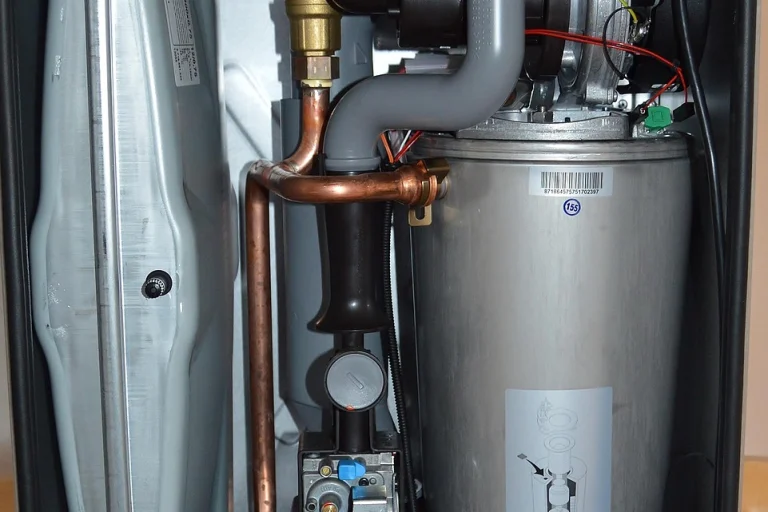
Water Heater Handbook is an independent, plain-English guide to home water heaters in the US: tank and tankless, gas and electric, and heat pump (hybrid) models. It explains why a heater leaks, bangs, smells or runs cold, what the maker’s own manual gives owners to do and where it says to stop, how to keep a heater going, and how old, how big and how costly to run a heater is. We cover problems and leaks, maintenance, parts and safety, tankless heaters, heat pump water heaters, and choosing and sizing.
General information, not professional advice. Gas, 240-volt power, scalding water and a pressurised tank can hurt you. Follow the label and manual on your own heater; where they say to stop and call a qualified technician, stop. Codes and licensing rules are set locally. If you smell gas, leave the building and call 911 or your gas utility from outside.
What we do
Most of what is written about water heaters is either a seller’s page or a summary of other summaries, and the sources that matter often disagree. Take flushing a storage tank. Rheem’s gas use and care manual (AP23698) suggests draining a few quarts every month; Bradford White’s gas installation and operation manual (238-51012-00V, REV 08/26) lists draining a gallon a month; A. O. Smith’s gas guide (100263112, January 2015) says to drain and flush after the first six months and then about once a year if there is little sediment; and the Department of Energy’s archived Energy Saver page said to flush a quart every three months (DOE, archived 1 May 2026). All four were read on 9 November 2026. None of them is wrong for its own heater, and none of them is an average of the others.
So every step, interval, temperature, size, pressure and figure on this site carries its source: the maker’s manual by part number and date, the federal rule by section, or the model code by section and edition, with the day we read it. Where sources disagree, we show each one side by side. Where the maker says a job is for a qualified service technician, our page says so at that step. Where a page has a sum to work out, such as a tank size from your busiest hour or a year’s energy cost, the calculator shows the arithmetic on numbers you enter. Our how we check page explains where each kind of fact comes from. Pages are published under the Water Heater Handbook name.
What we are not
Water Heater Handbook is not a plumber, a gas fitter, an electrician, a heating contractor, a water heater maker, a retailer, a gas or electric utility, or a government agency. We give general information, not professional advice. We have not seen your heater, your piping, your venting or your wiring, and we never diagnose a reader’s heater, by email or any other way. We never say that your heater is fine to keep running, that a repair is within your skills, or that an installation meets your local code. Pages explain what the parts do, what the maker’s label and manual say, what the federal rules and model codes say, and who decides.
How we are funded
Water Heater Handbook is free to read and is funded by display advertising. Ads may not appear yet while the site is new. Once they run, some may come from water heater makers, retailers, plumbers or other companies that sell to homeowners. An ad is not an endorsement, a referral or a recommendation, and advertisers have no say over what we publish. Nobody pays us anything to read a page or use a calculator.
How we stay independent
- No affiliate links. We earn nothing if you buy a heater, a part or a tool, or hire anyone, after reading a page.
- No paid placements. Nobody can pay for coverage, a mention or a better position.
- No sold leads. We collect no details about you or your home to pass on to plumbers, installers, makers, retailers or anyone else.
- No referrals. We don’t name, recommend or rank plumbers, gas fitters, electricians or installers, and we offer no “free quote” or “find a pro” service.
- No product rankings. We publish no “best water heater” lists and no model-by-model picks.
- No maker sponsorship. No maker pays for or reviews our pages. Makers are named only as the source of their own manual, label, serial number format or error code list, or where a page is about their product line.
That is why our pages can say things a seller might not: that the federal tax credit for water heaters ended for property placed in service after 31 December 2025 (IRS, read 9 November 2026), that Congress voided the Department of Energy’s December 2024 gas tankless standards (Public Law 119-6, approved 9 May 2025), or that a dripping relief valve is often a pressure question rather than a failed valve, as A. O. Smith’s guide explains.
How pages are checked
Every page gets a fact-check against its sources, separate from the writing. Each page ends with the date its sources were checked. Our editorial policy sets out each step.
Where to start
If there is water around your heater, water heater leaking goes through the places a leak shows up, in the order the makers check them. If you have no hot water, start with no hot water: a step-by-step check. If you want to know how old your heater is, the water heater age lookup reads the serial number formats we have confirmed from the makers. If you are choosing a new one, what size water heater do I need works from your busiest hour. If you smell gas or a carbon monoxide alarm sounds, don’t read on: get everyone outside and call 911 or your gas utility from there. Gas smell or carbon monoxide near a water heater explains what the federal agencies and the makers say, for afterwards.
Mistakes and questions
Our corrections page logs what we have fixed, and our contact page says how to reach us. Please read our disclaimer too.