Size a tank or heat pump water heater by its first hour rating, not by the gallons on the tank. Add up the hot water your household uses in its busiest single hour, then look for a heater whose first hour rating on the EnergyGuide label is at least that number. In the Department of Energy’s own worked example, three showers, one shave and one hand dishwashing come to 65 gallons (DOE’s page prints 66; see the worked example), so that household looks for a first hour rating of 65 or more. The calculator on this page, one of our choosing and sizing guides, does the same sum with your own uses, and you can change every per-use figure.
General information, not professional advice. Gas, 240-volt power, scalding water and a pressurised tank can hurt you. Follow the label and manual on your own heater; where they say to stop and call a qualified technician, stop. Codes and licensing rules are set locally.
This page covers storage tanks, gas and electric, and heat pump (hybrid) water heaters with a tank. A tankless heater is sized by flow, not by the hour: use the tankless size calculator for that. Water Heater Handbook sells, installs and recommends nothing.
What to enter
The method comes from DOE’s Energy Saver page “Sizing a New Water Heater”. The live page returns “not found” (checked 9 November 2026), so we cite the Internet Archive copy captured on 2 July 2026; its storage section is dated 21 August 2012. DOE’s steps are short: work out the time of day you use the most hot water, keeping in mind how many people live in the home, then count what happens in that one hour.
- Pick your busiest hour. For many homes it is the morning rush of showers, for others the evening of dishes, laundry and baths. If you can’t tell, run the calculator twice and keep the larger result.
- Count each use in that hour. Showers started within the hour, shaves at a running tap, hand dishwashing or food prep, dishwasher loads, and washing machine loads on a hot or warm setting.
- Check the gallons per use. The defaults are DOE’s figures. DOE calls them estimates “based on averages from a variety of information published on websites”, so change any that don’t fit your home: a long shower uses more than 20 gallons.
- Add anything DOE leaves out. DOE’s worksheet has no bath. Put a bath, a second sink or anything else in the “anything else” box, in gallons of hot water.
- Compare a label, if you have one. Enter the first hour rating from a heater you are looking at and the calculator says whether it meets your estimate and by how much.
DOE’s worksheet notes that it “does not estimate total daily hot water usage”. The calculator doesn’t either. It estimates one hour, which is the hour a tank has to survive.
DOE’s figures for each use
| Use | Gallons of hot water each time (DOE estimate) |
|---|---|
| Shower | 20 |
| Shaving (DOE: “.05 gallon per minute”) | 2 |
| Hand dishwashing or food prep (DOE: “2 gallons per minute”) | 3 |
| Automatic dishwasher | 7 |
| Clothes washer, top-loader | 25 |
| Clothes washer, front-loader (DOE: “H-Axis”) | 15 |
Worked example, and the 66 that should be 65
General information, not professional advice. Gas, 240-volt power, scalding water and a pressurised tank can hurt you. Follow the label and manual on your own heater; where they say to stop and call a qualified technician, stop. Codes and licensing rules are set locally.
DOE’s example household has three showers, one shave and one hand dishwashing in its busiest hour.
| Use | Gallons each | Times in the hour | Gallons |
|---|---|---|---|
| Shower | 20 | 3 | 60 |
| Shave | 2 | 1 | 2 |
| Hand dishwashing | 3 | 1 | 3 |
| Peak hour demand | 65 |
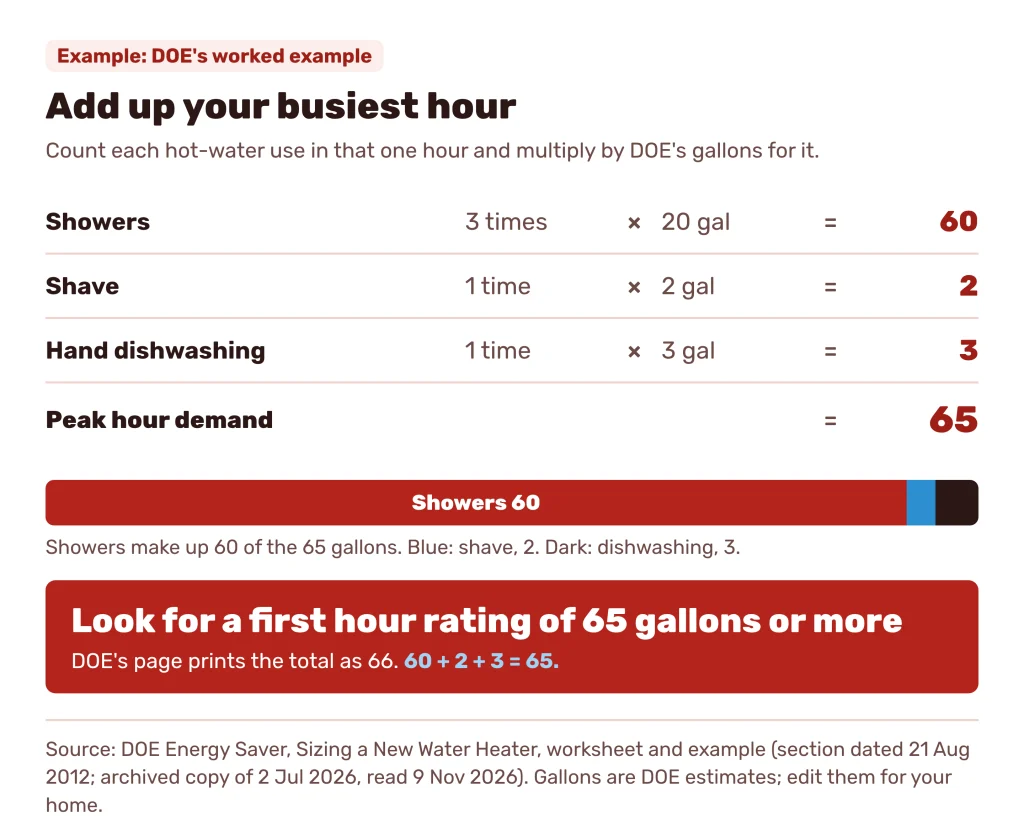
The one-gallon slip changes little in practice, but it’s worth knowing if you check our result against DOE’s page. Two more households, run through the same calculator:
- Four showers, a shave, the dishwasher and a front-loader load in the same evening hour: 80 + 2 + 7 + 15 = 104 gallons. Showers make up 77% of that hour.
- One shower and a sink of dishes: 20 + 3 = 23 gallons. A small household’s busiest hour can be small enough that tank choice turns on other things, such as fuel, space and running cost.
In DOE’s example and in both of ours, showers are most of the hour. Before you fine-tune anything else, get the number of showers and their length right.
What the first hour rating measures
The federal test procedure defines the first hour rating as “an estimate of the maximum volume of ‘hot’ water that a non-flow activated water heater can supply within an hour that begins with the water heater fully heated” (10 CFR Part 430, Subpart B, Appendix E, section 1.5, read 9 Nov 2026). “Non-flow activated” covers heaters that don’t wait for water to flow before they heat, which in practice means storage tanks and heat pump water heaters with a tank (flow-activated is defined in section 1.6). It counts what the tank holds plus what the burner, elements or heat pump can heat while you keep drawing.
The test runs under fixed conditions, also from Appendix E:
- Cold water goes in at 58°F, plus or minus 2°F (section 2.3).
- The heater is set to deliver 125°F, plus or minus 5°F (section 2.4).
- Water is drawn at 3 gallons a minute for tanks of 20 gallons or more (section 5.3.3.1).
- Each draw stops when the outlet temperature falls 15°F below the hottest reading in that draw, and the next draw starts when the heater’s controls cut back the burner, element or compressor (sections 5.3.3.2 and 5.3.3.3).
That is why DOE says the rating depends on “the tank capacity, source of heat (burner or element), and the size of the burner or element”. The rating also decides which daily draw pattern the heater is tested under for its efficiency rating (Appendix E, Table I), so two heaters in different groups were tested under different daily draws.
Where to find it on the EnergyGuide label
The Federal Trade Commission’s labeling rule requires a storage water heater’s EnergyGuide label to show capacity two ways: the rated storage volume (“tank size (storage capacity)”) and the first hour rating (16 CFR 305.17(a)(4), with the capacity rule in 16 CFR 305.10(d), read 9 Nov 2026). DOE’s page says it sits in the top left corner as “Capacity (first hour rating)”. A tankless heater’s label shows gallons per minute instead. The maker’s spec sheet usually lists the first hour rating too.
Heat pump water heaters are covered too. DOE’s archived page says the FTC “requires an EnergyGuide label on all new conventional storage water heaters but not on heat pump water heaters”. That is out of date. The current rule’s description of a water heater includes heat pump units with a maximum current rating of 24 amps at no more than 250 volts, so a heat pump model within those limits gets the label (16 CFR 305.3(d)(3), read 9 Nov 2026), and ENERGY STAR lists a first hour rating for every certified heat pump model.
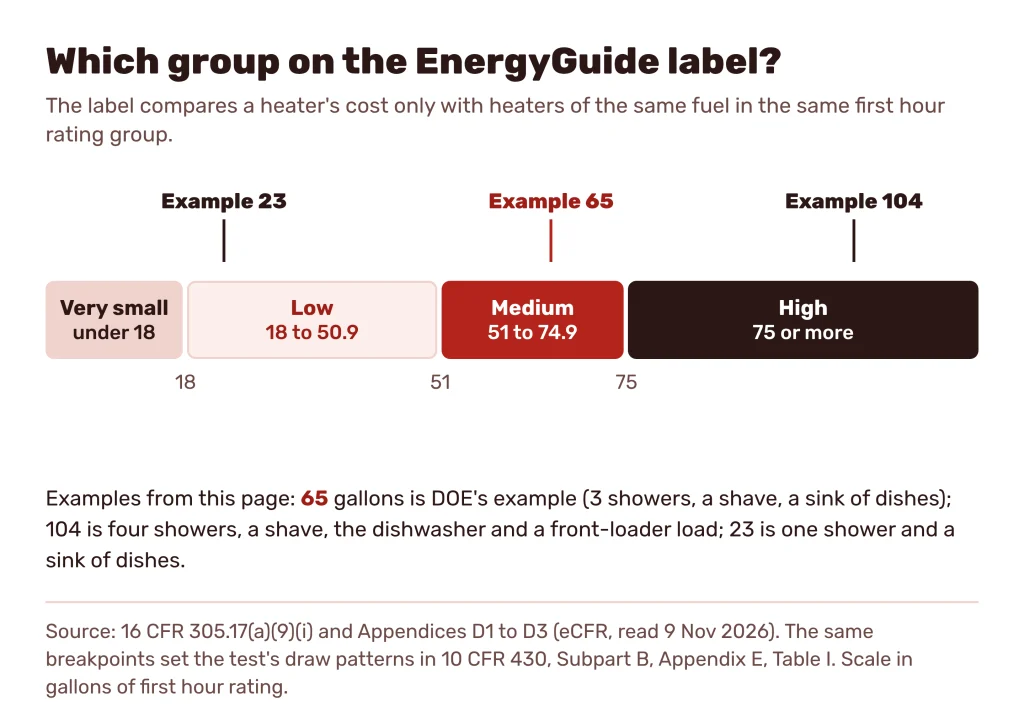
The label’s cost range compares a model only with models of the same fuel in the same first hour rating group. The calculator tells you which group your estimate falls in:
| Group on the label | First hour rating |
|---|---|
| Very small | fewer than 18 gallons |
| Low | 18 to 50.9 gallons |
| Medium | 51 to 74.9 gallons |
| High | 75 gallons or more |
Every water heater label must carry the line “Federal law prohibits removal of this label before consumer purchase” (16 CFR 305.17(a)(10)). If you are buying from a listing rather than looking at the heater, ask for the label or the maker’s spec sheet before you commit.
Same tank, different rating
Two heaters with the same tank can deliver quite different amounts of hot water in an hour. ENERGY STAR’s public lists of certified models show it plainly (the datasets ENERGY STAR Certified Heat Pump Water Heaters and ENERGY STAR Certified Gas (Storage and Tankless) Water Heaters, updated 8 Nov 2026, downloaded and counted by us on 9 Nov 2026):
| Certified models with this rated tank | Models listed | First hour rating range |
|---|---|---|
| Heat pump, 45 or 46 gallons rated, 240 V | 161 | 52 to 73 gallons |
| Heat pump, 45 or 46 gallons rated, 120 V | 23 | 50 to 55 gallons |
| Gas storage, 49 gallons rated, 50,000 Btu/h input | 1 | 98 gallons |
| Gas storage, 49 gallons rated, 65,000 Btu/h input | 16 | 118 gallons |
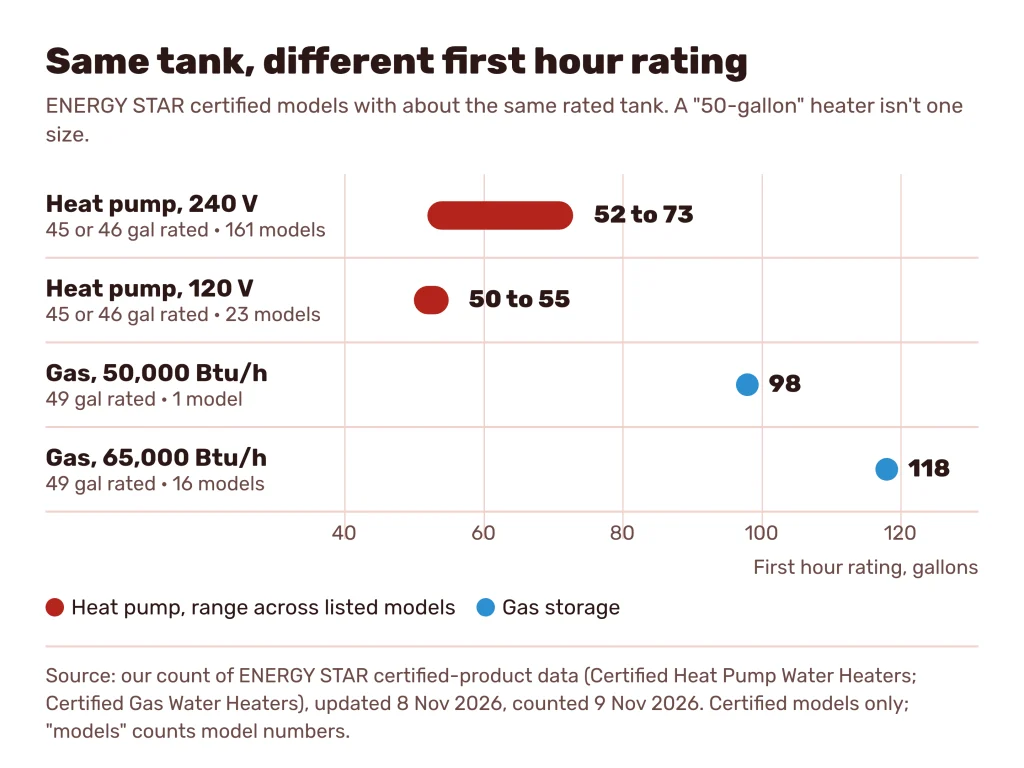
Two things stand out. Among heat pump models, the 120-volt ones sit at the low end of the range, which matters if your busiest hour is in the 60s. Among the 49-gallon gas tanks, the one model with a 50,000 Btu/h burner is rated 98 gallons and the 65,000 Btu/h models 118: one model is a small sample, but the bigger burner rates higher. So a “50-gallon” heater isn’t one size. Compare first hour ratings, not tank sizes.
ENERGY STAR itself sets a floor: a certified electric storage heater, which covers heat pump models, needs a first hour rating of at least 45 gallons, and a certified gas storage heater at least 51 (ENERGY STAR key product criteria, read 9 Nov 2026). Those are entry rules for the label, not sizing advice. If you are weighing a heat pump model, our heat pump water heater fit check looks at the room and circuit it needs.
Turning the number into a choice
- Start from the estimate. DOE’s rule is a first hour rating that at least matches your peak hour demand. The calculator rounds up to the next whole gallon.
- Keep the margin honest. DOE says a properly sized heater “will meet your household’s hot water needs while operating more efficiently”. DOE gives no figure for how far above your estimate to go, and neither do we. If you are unsure of your count, run the calculator again with the higher numbers and compare.
- Compare within the label’s group. Once you know the group, compare the yearly energy cost on the labels of models in it. Our yearly energy cost calculator compares fuels.
- Check that it fits the space and the supply. A larger tank or a higher-input burner needs room, venting and a gas or electric supply to match, and some homes require a permit. Ask your building department; prices vary, so get written quotes.
For combination water and space heating systems, including tankless coil and indirect water heaters, DOE’s page says to consult a qualified contractor. This calculator doesn’t size those.
Where the estimate can mislead
- Cold winter water. The rating is measured with 58°F water coming in. Where the incoming water is colder in winter, the heater has more work to do for each gallon, and the hot water you get in an hour can fall short of the label (our reasoning from the test conditions; DOE’s page gives no figure for it).
- Long showers and big heads. DOE’s 20 gallons is an estimate. Federal rules cap new showerheads at 2.5 gallons a minute, measured at 80 psi (10 CFR 430.32(p), for heads made after 1 January 1994), so a ten-minute shower at that flow runs up to 25 gallons of mixed hot and cold water (our arithmetic). Older heads and multi-head showers can use more.
- Baths. DOE’s worksheet doesn’t include them. Enter your own figure.
- Turning the thermostat up instead. A hotter tank stretches the hot water, but it raises the burn risk. CPSC recommends 120°F and says water at 130°F can cause a third-degree burn in most adults in 30 seconds, against 5 minutes at 120°F (CPSC Publication 5098, March 2012). A. O. Smith’s gas manual says that if you set its control above 120°F, install thermostatic mixing valves at each point of use and set those no higher than 120°F (Use & Care Guide 100263112, January 2015, p. 25). Our temperature setting guide covers this in full.
- Tankless. A tankless heater has no store to draw down. It is sized by how many fixtures run at once and how much it has to raise the water’s temperature.
About the “gallons per person” charts
You may see charts elsewhere that turn household size straight into a tank size. We found no federal source behind them, and DOE’s method doesn’t use one: it asks what happens in your busiest hour. Two households of four can have very different mornings, and two “50-gallon” heaters can deliver very different first hours, as the table above shows. Use a chart as a rough check if you like, but buy on the first hour rating.
Running out of hot water now?
A heater that used to keep up and now doesn’t may have a fault rather than a size problem. A. O. Smith’s manual for its atmospheric gas heaters lists several causes of water that isn’t hot enough besides a heater that’s too small for the use: a faulty mixing valve in a faucet or shower control, reversed plumbing connections or a melted dip tube (usually soon after a new install), a plumbing leak, and sediment or lime in the bottom of the tank (100263112, January 2015, p. 25). Electric heaters have their own list of causes in their makers’ manuals. Work through our no hot water check before you size a replacement, and follow the label and manual on your own heater.
Your next step
- Run the calculator for your busiest hour. Use real counts, and edit the shower gallons if your showers run long.
- Read the rating plate on your current heater. Note the fuel, the gallons and the input (Btu/h for gas, watts for electric), plus the model number. Look up that model’s first hour rating in the maker’s literature to see how your estimate compares with what you have now.
- Compare labels, not tank sizes. On any heater you consider, read “Capacity (first hour rating)” on the EnergyGuide label or the maker’s spec sheet, and enter it in the calculator.
- Ask about permits and get written quotes. Installation rules are set locally, and a different size, fuel or type can change the venting, wiring or gas supply.
Sources checked on 9 November 2026: DOE Energy Saver, Sizing a New Water Heater (archived 2 Jul 2026); 10 CFR Part 430, Subpart B, Appendix E and 10 CFR 430.32 (eCFR, up to date 5 Nov 2026); 16 CFR Part 305 (eCFR, up to date 5 Nov 2026); ENERGY STAR key product criteria and certified-product data (updated 8 Nov 2026); CPSC Publication 5098; A. O. Smith 100263112.
Formulas and sources
- Showers, gallons in the hour: DOE Energy Saver: Sizing a New Water Heater, storage section dated 21 Aug 2012 (live page 404; Internet Archive capture 2 Jul 2026)
- Peak hour demand, estimate: DOE Energy Saver: Sizing a New Water Heater, storage section dated 21 Aug 2012 (live page 404; Internet Archive capture 2 Jul 2026)
- First hour rating to look for, estimate: DOE Energy Saver: Sizing a New Water Heater, storage section dated 21 Aug 2012 (live page 404; Internet Archive capture 2 Jul 2026)
- Showers' share of the busiest hour: DOE Energy Saver: Sizing a New Water Heater, storage section dated 21 Aug 2012 (live page 404; Internet Archive capture 2 Jul 2026)
- EnergyGuide first hour rating group: 16 CFR 305.17 and Appendices D1-D3: EnergyGuide label for water heaters, first hour rating bins, eCFR up to date 5 Nov 2026
- Label you entered against the estimate: DOE Energy Saver: Sizing a New Water Heater, storage section dated 21 Aug 2012 (live page 404; Internet Archive capture 2 Jul 2026)
- Label minus the estimate: DOE Energy Saver: Sizing a New Water Heater, storage section dated 21 Aug 2012 (live page 404; Internet Archive capture 2 Jul 2026)
Sources
- DOE Energy Saver: Sizing a New Water Heater (storage section dated 21 Aug 2012; live page 404, Internet Archive capture 2 Jul 2026)
- 10 CFR Part 430, Subpart B, Appendix E: Uniform Test Method for Measuring the Energy Consumption of Water Heaters (eCFR, up to date 5 Nov 2026)
- 10 CFR 430.32(p): showerhead maximum flow (eCFR, up to date 5 Nov 2026)
- 16 CFR 305.17: Label content for water heaters (eCFR, up to date 5 Nov 2026)
- 16 CFR Part 305: Energy and Water Use Labeling for Consumer Products (305.3(d), 305.10(d), Appendices D1-D3)
- ENERGY STAR: Residential Water Heaters Key Product Criteria
- ENERGY STAR Certified Heat Pump Water Heaters (dataset v7jr-74b4, updated 8 Nov 2026)
- ENERGY STAR Certified Gas (Storage and Tankless) Water Heaters (dataset 6sbi-yuk2, updated 8 Nov 2026)
- CPSC Publication 5098: Avoiding Tap Water Scalds (March 2012)
- A. O. Smith: Installation Instructions and Use & Care Guide, Residential Atmospheric Gas Water Heater with FVIR, 100263112 (January 2015)